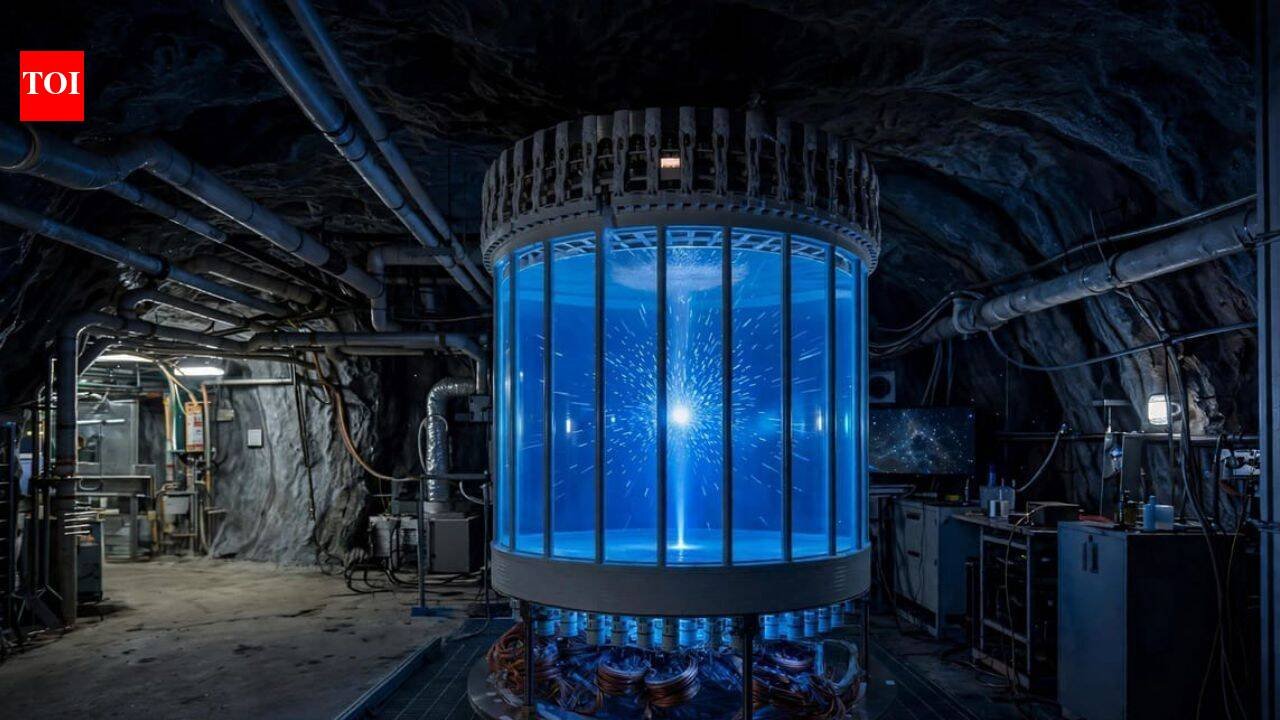
Scientists working on the LUX-ZEPLIN (LZ) dark matter experiment have identified a single particle interaction that they have struggled to explain using any known background process. The detector operates nearly a mile underground at the Sanford Underground Research Facility in South Dakota, US, where it searches for signs of dark matter.The result is the most compelling hint of dark matter reported by the experiment so far, although it does not meet the statistical threshold required to claim a discovery. Dark matter is thought to make up around 85% of all matter in the universe, yet it has never been directly detected.According to UK Research and Innovation (UKRI), the analysis was led by the University of Bristol and presented at the 2026 TeV Particle Astrophysics conference in Japan.



What did the underground detector discover in its search for dark matter
The LZ experiment identified a single particle interaction in a region of its dataset that researchers had not previously explored. The team spent months investigating possible causes, including known background processes that can produce signals inside the detector.The event stands out because researchers understand the detector and its background signals well, making an unexplained interaction important to investigate.However, the finding does not confirm the presence of dark matter. The result has a statistical significance of 2.6 sigma, indicating a roughly 0.5% chance that known background processes alone could explain the event. Physics requires a significance of 5 sigma before a result can be declared a discovery.
How the LZ detector searches for dark matter deep underground
The LZ experiment uses 10 tonnes of ultrapure liquid xenon to search for weakly interacting massive particles, known as WIMPs. These hypothetical particles are among the candidates researchers investigate in the search for dark matter. The detector operates nearly a mile underground at the Sanford Underground Research Facility in South Dakota, US.The experiment is managed by the US Department of Energy’s Lawrence Berkeley National Laboratory and brings together around 250 scientists and engineers from 39 institutions worldwide. Researchers look for rare interactions that might provide evidence of dark matter.
What could the unexplained particle interaction tell scientists about dark matter
If the event was the result of a dark matter interaction, it would point to a WIMP with a mass of at least 200 GeV/c² (gigaelectron volts), making it more than 200 times the mass of a proton. Its interaction with ordinary matter would fall outside the simplest theoretical models.However, researchers have not confirmed that the signal came from dark matter. Rick Gaitskell, a professor at Brown University and the LZ spokesperson, said, “We’re very intrigued to see this event in the data, in the region where we expect dark matter to show up and the competing backgrounds are very low”.“With only one event, we don’t want to get ahead of ourselves. We are not claiming to have seen dark matter. But we have seen something interesting that we want to share with the scientific community for their input”.
How the LZ team plans to investigate the signal and advance dark matter research
The LZ collaboration will continue collecting data at the Sanford Underground Research Facility to determine whether the signal grows stronger, weakens or disappears as more observations become available. The UK has played a central role in the experiment, with 10 teams contributing to its construction and operations and around 50 UK researchers involved in operations, data analysis and collaboration leadership since commissioning in 2021.The UK team is also working with international partners on XENON-LUX-ZEPLIN-DARWIN, a next-generation rare-event observatory designed for dark matter detection and neutrino physics. The project currently receives support through a UKRI Infrastructure Fund preliminary activity. The UK is also exploring the possibility of hosting the experiment at the Boulby Underground Laboratory, supporting plans for further research into rare particle interactions.