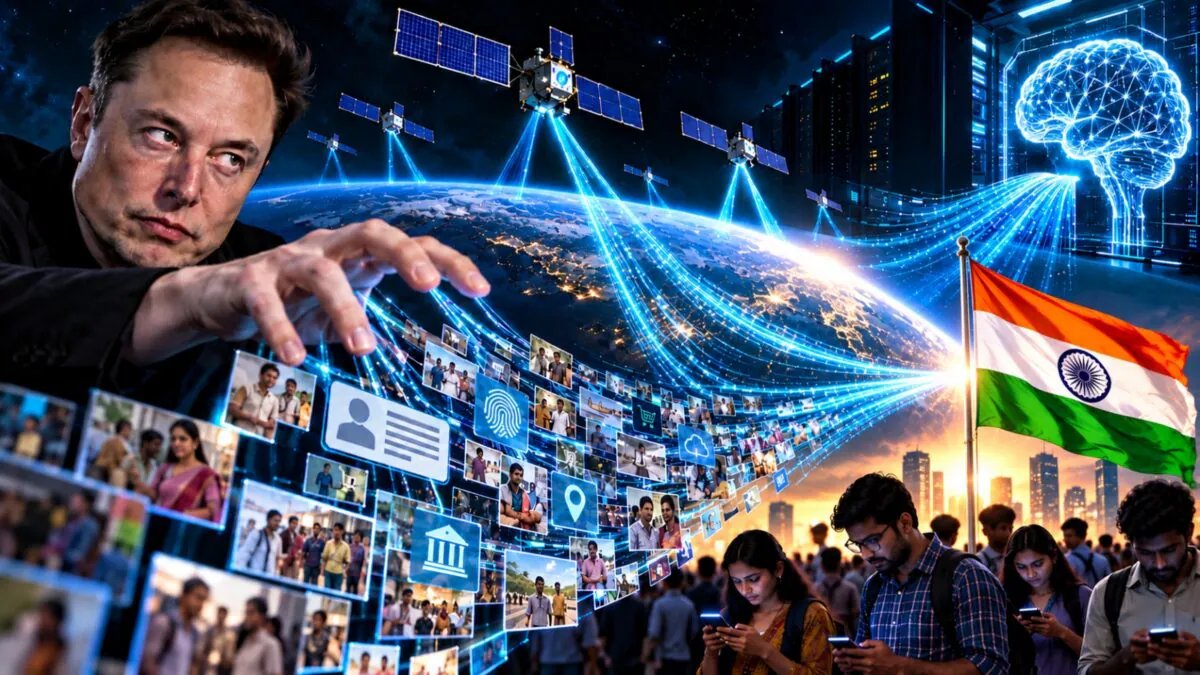
New Delhi: A new report of Takshashila Institute has raised serious questions regarding satellite internet. Elon Musk’s company SpaceX is preparing to launch Starlink services in India. According to the report, the company’s global privacy policy links users’ personal data to Musk’s artificial intelligence project. Under this, information related to customer’s location, IP address and audio or visual communication can be used to train the machine learning model. This arrangement could pose a challenge to data sovereignty amid the potential reach of Starlink in India. The question before the security agencies is how to maintain effective control over foreign satellite networks. Despite the rules of the Government of India, the possibility of users’ information reaching outside the country due to technical flaws is also being discussed.



Will Musk keep an eye on your every online activity?
Starlink changed its global privacy policy on January 15, 2026. According to the report, under this change the company can collect electronic files related to customers’ location, Internet protocol address and conversations. The company has said in its policy to use this data to train machine learning and AI models.
The biggest concern expressed in the report is that users may be considered automatically involved in the arrangement of data use. This means that the data of customers taking Starlink services can be used in the company’s system. According to the report, the arrangement for taking separate approval for this is not clear. The policy also includes the possibility of sharing data with third-party partners.
Is Grok AI being trained by conversations of Indians?
Elon Musk has previously spoken publicly about the importance of the data he receives from his business. The report mentions his statement in which he had said that real-time data would be available through Tesla, Starlink and Twitter.
Data of Indian users is an important part of this debate. India is a huge digital market where huge amounts of data is generated every day. If Starlink’s services reach remote areas, then the data of the users there may also come under the purview of the company’s policies. This may include information related to video calls and other digital communications.
According to the report of Takshashila Institute, such a system can create risks regarding large-scale surveillance and use of data. The concern is not limited to internet service only. The question is also who will have control over the users’ information and for what purposes it can be used.
How much control do India’s security regulations have over foreign satellite companies?
The Indian Department of Telecommunications had issued security related conditions for satellite internet companies in May 2025. These terms relate to the GMPCS license arrangement. Under these, rules have been implemented regarding routing and monitoring of data of Indian users.
It has been told in the report that the traffic of Indian users should pass through the gateway present in the country. Security related restrictions also apply when data is transmitted to other countries through satellite networks. Apart from this, the company has to follow the conditions related to security and decryption of Indian data.
However, the report has raised questions on the practical implementation of these rules. Monitoring every activity of the satellite network in space can be technically challenging. If any method of data transfer is used to circumvent the rules, independent technical monitoring will be necessary to detect it. That is why along with making rules, the ability to check their compliance is also important.
Can Musk shut down India’s internet services during times of crisis?
- starlink Concerns are not limited to data security alone. It is also related to national sovereignty and control over communication systems in times of crisis. Elon Musk’s role during the Ukraine war intensified international debate over private companies’ control of satellite internet services.
- Many controversies arose regarding the availability and use of Starlink during military operations in Ukraine. Decisions related to providing services in the context of the Ukrainian campaign near Crimea were also discussed. This case showed that in a war-like situation, decisions of a private company can affect military communications.
- This issue is important for India also. Satellite internet can become an important communication medium during border disputes, natural disasters or national emergencies. In such a situation, clear rules are necessary regarding the availability of the service and the control over it by the Indian authorities.
US laws and government orders may also impact access to data. India must therefore ensure that clear legal and technical safeguards are in place for access to sensitive data and the operation of emergency services.
Cases of use of Starlink surfaced in Manipur and sea borders
In December 2024, security forces in Manipur had recovered Starlink terminal from militant hideouts. This incident raised concerns about the use of unauthorized satellite equipment in India. At that time, Elon Musk had claimed on social media that Starlink satellite beam is closed over India.
This case raised questions about the effectiveness of geofencing and controls on the use of devices. Availability of satellite signals in border areas and preventing the use of unauthorized devices can be a challenge for security agencies.
The report also alleges that investigating agencies faced difficulty in obtaining data and usage records. In such cases, it should be clear under which legal process the company will give information to Indian agencies. The process of sharing data is an important part of the security system in the investigation of cross-border crimes.
What decision did In-Space make on Starlink’s direct-to-mobile plan?
- Starlink’s next generation satellite technology has been mentioned in the report regarding the decisions of India’s space regulator In-Space. Gen 2 networks include direct-to-device technology. Through this, compatible mobile phones can connect directly to the satellite and in some circumstances there is no need for a separate dish antenna.
- According to the report, the regulator did not approve Starlink’s Gen 2 network and cited permission for 4,408 Gen 1 satellites. To confirm this claim, it is necessary to see the official order of In-Space and the terms of approval.
- Direct-to-device technology may further increase the need for regulatory oversight. If mobile phones connect directly to satellite, separate technical arrangements will be required to implement data routing and security requirements. Therefore, while approving such services, it is important to examine aspects related to data localisation, monitoring and access by law enforcement agencies.
The National Satcom Monitoring Facility is also mentioned in the report. Its objective is to strengthen the monitoring capacity of satellite communications in the country. Adequate technical resources and trained personnel will be necessary for effective operation of such a system.
What can India do to reduce the risks of foreign satellite companies?
- Researchers of Takshashila Institute have given many suggestions to the Government of India. These include increasing the budget of Digital India Fund and strengthening internet connectivity in rural and remote areas. Expansion of government broadband services through optical fiber can be an option to reduce dependence on foreign satellite networks.
- India may also give preference to companies that are willing to work with local partners and comply with the country’s laws. However, merely having an Indian stake does not guarantee data security. For this, independent audit, clear accountability and effective action on violation of rules are also necessary.
- Rules can be made based on risk for the use of services like Starlink. Satellite internet can be useful for disaster management and connectivity in remote areas. But additional security measures are necessary to protect sensitive government communications and citizens’ personal data.
A clear legal framework should also be created for direct-to-mobile satellite services. It should be clear on what conditions foreign companies will be allowed to use the data of Indian citizens to train AI models. To protect national security and digital sovereignty, their effective monitoring along with transparent rules is also necessary.