The last few weeks have been challenging for Harmanpreet Kaur. After ceding the captaincy of the Indian women’s team, which she held for over a decade, her spot in an evolving outfit was finally at the mercy of form.


Given her hot and cold returns across formats, a stunning 91 in the final T20I against Zimbabwe in Raipur broke the dam, with the former India captain reduced to tears while attempting to explain the relief of finding rhythm. Five sixes in a 41-ball blitz underlined it quite emphatically.
Six days later, on an unforgivingly hot afternoon at the BCA Stadium in Kotambi, Harmanpreet registered another big score, an almost instructive 121-ball 126.

After a prolonged lean run, Harmanpreet Kaur finally found her rhythm with two big scores against Zimbabwe.
| Photo Credit:
BCCI/X

After a prolonged lean run, Harmanpreet Kaur finally found her rhythm with two big scores against Zimbabwe.
| Photo Credit:
BCCI/X
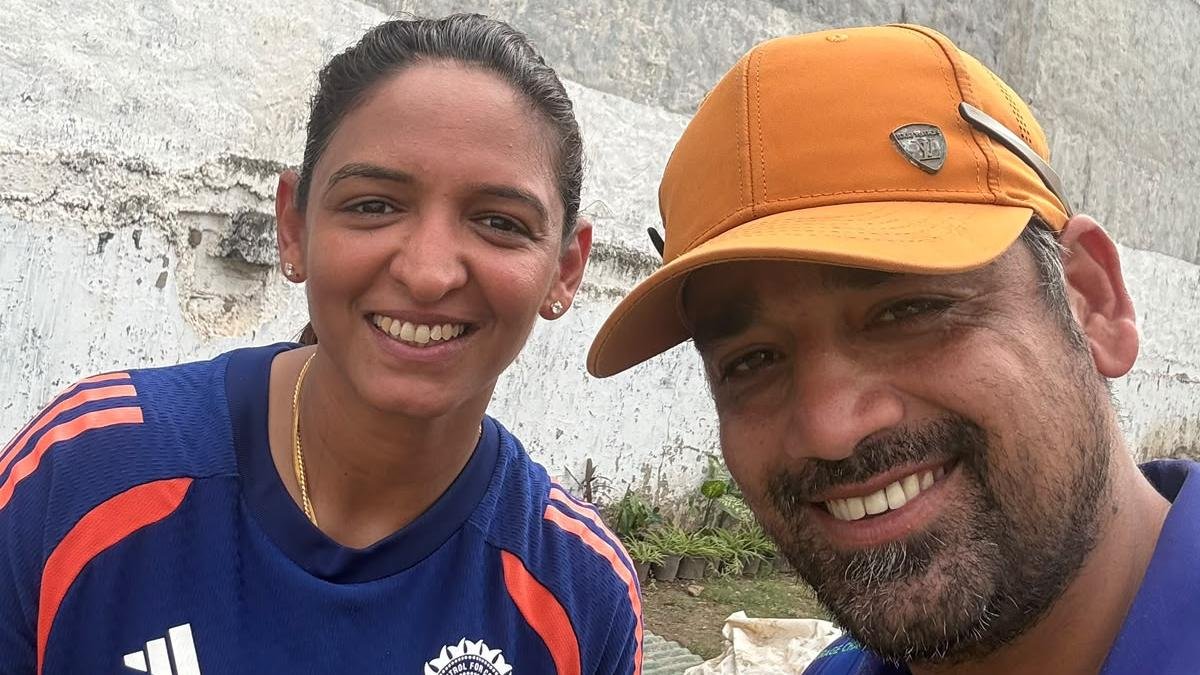
Watching along in Patiala was her batting coach, Himanshu Chawla. Both hail from Punjab and knew of each other, but their coaching association was serendipitous.
Connect and then correct
Harmanpreet often trained at the Cricket Academy of Patiala, where Himanshu coaches. A few years ago, fresh from an underwhelming overseas assignment, she was in the middle of a routine net session with Himanshu observing from the sidelines.
“We had a general chat, as players, and I pointed out that she wasn’t holding her bat properly,” Himanshu told Sportstar.
“It’s not something you lightly point out to someone who has played for over a decade. She was also the captain then. But I pointed that out. Immediately, she replied, saying this is exactly what the India coach, Amol Muzumdar, had told her. She may have understood then that I knew what I was talking about. She asked me how to fix that. I asked her to join me in training the next day, and from then on, we began working together.”
The two get along famously, something he says is important in a coaching relationship.
“Dr. Kinjal Suratwala (a former sports science expert at the National Cricket Academy), one of my earliest mentors, always said, ‘connect before you correct.’ To have that ease and that bond is important before we get down to working on a player.”
ALSO READ | How watching highlights of her NZ ton helped Pratika Rawal answer India’s opening question
Himanshu knew very early that his job here would not be to coach technique to one of the stalwarts of the game. The mind was where the problems were, and his own cricketing career, and the mentors he had, helped him navigate that for Harmanpreet too.
“I’ve understood one thing. Technique and form are temporary. Class is permanent. But in dono ke beech mein player phas jaata hai (but a player gets stuck between these two concepts),” Himanshu explained.
“When we are scoring, we feel we are technically sound, but when the runs don’t come, that same technique can feel faulty. With Harmanpreet, we know she is a stroke player. At the time, she was struggling with her timing. The grip of her bat, or the bat being a little bent due to how she held her bottom hand, are all little things. I didn’t tell her anything she didn’t already know, but if there was one thing missing, I thought it was intent.
“The focus in our drills has always been about how she will face the ball mentally, not technically. After playing for so long, fear of failure is one major thing that makes you take bad decisions, and she faced that.”
Himanshu, by his own admission, is a talker. There’s an example for everything, an anecdote for every situation. And being Punjabi, there was a trove of local heroes – many of whom Harmanpreet idolised as she grew in the sport – to use as learning tools with this big-hitting phenom from Moga.
“(Virender) Sehwag can’t play like Rahul Dravid, right? Even if he is given captaincy. Harmanpreet was a lot like Sehwag. She’d take her chances. She does that even now. When she became captain, though, I don’t know how deliberately this happened, but her game shifted. The focus became about finishing the match because she is the leader, and so the natural thought was that she couldn’t take chances,” he remembered.
But this is not Harmanpreet’s style, and the incongruence, sure enough, led to some pretty visible cracks in her game.
“All I had to do was remind her of how she used to play and figure out why she was getting into a shell. It’s all about perspective.”
“We have this tendency of finishing training and then telling players, ‘ok, go have breakfast or lunch and come back; we’ll meet for another session.’ Similarly, when Harmanpreet came, she batted for two hours in the morning. I jokingly told her to have breakfast and come at 12. And there she was. The same thing happened, and she was there in the evening. We did a round of open nets. So that three-session schedule stuck”Himanshu Chawla
No one size fits all
Two days after her sensational 91 in Raipur, Himanshu got in touch with Harmanpreet to congratulate her and to check in on how she was feeling about her game heading into the ODIs. The response came almost immediately: “ Aise hi kheloongi (I’ll play the same way)!”
“In our chat, I told her she had to tune her game to the format a little. That was a T20I; this is ODIs. She needs to stick around till the 45th or 46th over. The team was playing the 50-over format after more than eight months or so, and it was important for Harmanpreet to play long instead of fast. Once you’re in the 43rd-44th over, your T20 game can take over. Funnily enough, she got out in the 47th.”
Harmanpreet is a good student and diligently obeyed. There was nothing overtly risky. She neglected her favourite midwicket region and put on an exceptional off-side batting masterclass, with crisp cut shots and eye-catching drives where she held the pose and relished her strokeplay. All this in testing heat and despite being down with a fever the night before.

Harmanpreet Kaur channelled her off-side range during her 121-ball 126 against Zimbabwe in the second ODI.
| Photo Credit:
CricViz
Harmanpreet Kaur channelled her off-side range during her 121-ball 126 against Zimbabwe in the second ODI.
| Photo Credit:
CricViz
In a video published by the BCCI after her knock, Harmanpreet spoke about going through rigorous batting drills three times a day when she was home after leading India to victory in the Asia Cup and the Asian Games.
“The more you bat, the more confidence you gain. I did three sessions of batting during my time at home. I am someone who needs a lot of training. Looking at my age now, I do have to spend time on my fitness too. There have been some shortcomings in my batting off late, so I wanted to work on it,” she said.
Himanshu chuckles when remembering how that routine came about.
“In the NCA (the Centre of Excellence’s predecessor), we have this tendency of finishing training and then telling players, ‘ok, go have breakfast or lunch and come back; we’ll meet for another session.’ Similarly, when Harmanpreet came, she batted for two hours in the morning. I jokingly told her to have breakfast and come at 12. And there she was. It was October 2; I had a holiday at work, so I was at the academy all day. The same thing happened, and she was there in the evening. We did a round of open nets. So that three-session schedule stuck.
“Remember, these were all batting drills. She did her gym and other training outside this. And this wasn’t even after she left captaincy, for it to be something she was doing from a need to prove herself. She just wanted to get better.”
ALSO READ | Smriti Mandhana and Harmanpreet Kaur: Two leaders, one dressing room
Himanshu mentions how refreshing it was for a player of her stature to be so open to feedback and unlearning. The pair worked on her shot choices, broke down innings building to the very basics, and worked on 25-minute blocks focused on one aspect – singles, playing spinners, sweeps, lifts, slogs and the works.
Himanshu pushed her to play along the ground, to take on short balls but minimise the risk. He also encouraged her to open up her scoring radar and find runs around the dial. This included skill sessions and match simulations.
More than anything, the emphasis on staying, in the longer formats, paid off, as Harmanpreet ground her way out to her eighth ODI hundred, going level with former India captain Mithali Raj and dear rival and former Australian skipper Alyssa Healy.

Despite focussing on the off-side, Harmanpreet made sure to utilise the on-side as well during her eighth ODI ton.
| Photo Credit:
CricViz
Despite focussing on the off-side, Harmanpreet made sure to utilise the on-side as well during her eighth ODI ton.
| Photo Credit:
CricViz
The privilege of pressure
While she’s been quizzed about it constantly – the liberation of not having captaincy to worry about anymore – Himanshu doesn’t think the pressure of the job was what was ailing her.
“I don’t agree with that perspective at all. My best years came when I was captain. Who do we make the monitor of the class? The naughtiest kid, right? We give responsibility to let them get serious. Harman has a strong personality. She’s Punjabi. Added pressure always brings discipline to a Punjabi. Pressure is privilege, as Kapil (Dev) paaji says. Give them responsibility or a position, and you’ll see them grow, or they stay naughty,” he quipped.
But the fear of failure? That’s a pretty strong inhibitor, and Himanshu doesn’t mind reminding his ward that it’s time to make peace with it.
“Cricket is a game of failure. Even the best, your Kohlis and Tendulkars, average in the 50s. It’s not a 100, which means they have not only brilliant innings, but they also have the bad ones and these are the best players in the world. We often have to remind people of this.”
It’s not all selfless. Himanshu bhaiya lives the games Harmanpreet plays.
“I played my last match in 2015-16 in the Syed Mushtaq Ali Trophy, ending a 12-year-long career. But I couldn’t play for India. When we plan and I see her executing that in a game, I feel like I am there,” he said.
Like a river after a long dry spell, form is finding its way back to Harmanpreet, quietly and steadily. Big assignments lie downstream, including the Women’s Champions Trophy, and India will need Harmanpreet at her flowing best.
Published on Oct 26, 2026