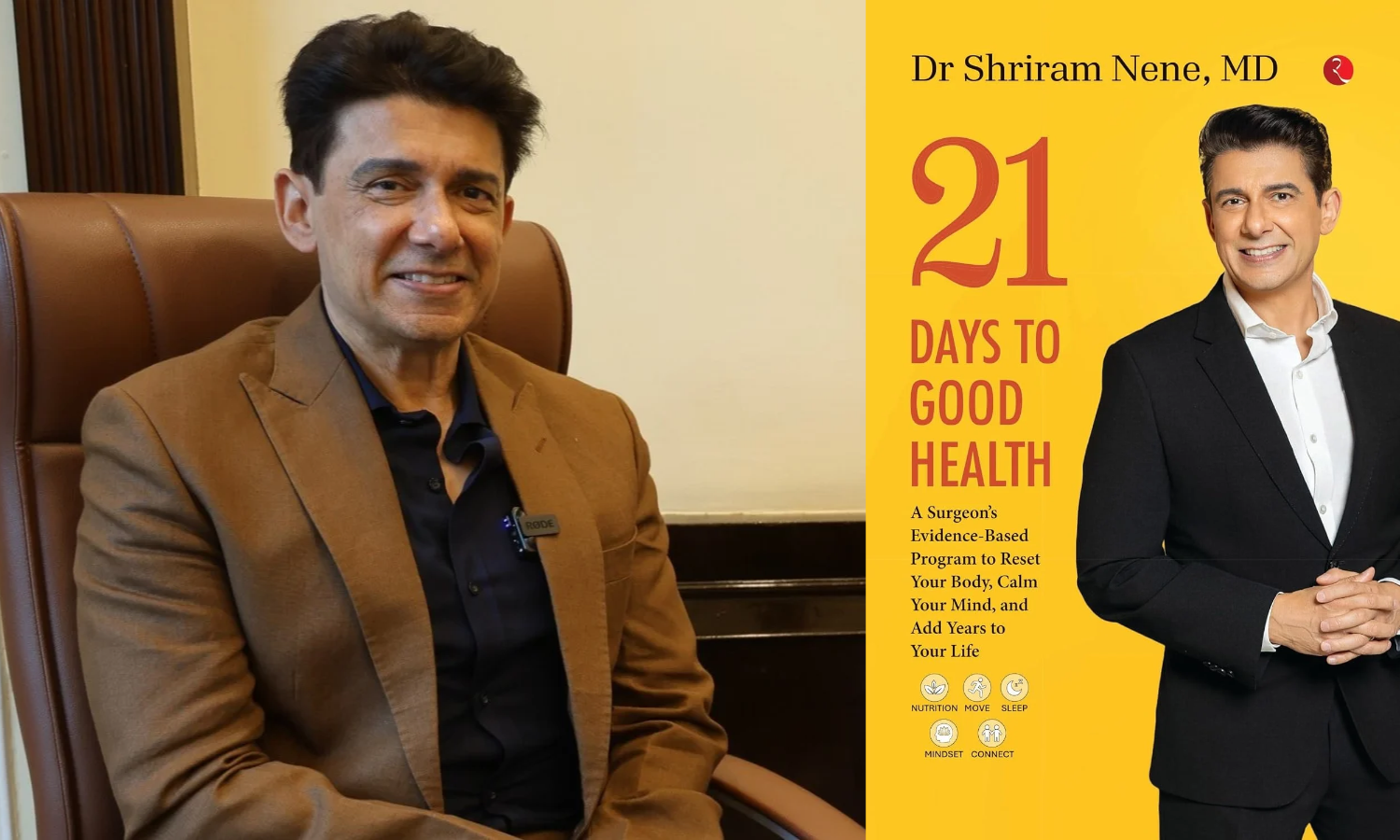
For Dr Shriram Nene, years spent treating patients as a cardiologist and cardiovascular and thoracic surgeon brought home a difficult realisation: by the time many people reached the operating table, the damage had been accumulating for decades. His book, 21 Days to Good Health, is an attempt to address that gap by making preventive healthcare a part of everyday life rather than something people turn to after a diagnosis.



“As a heart surgeon, you would come in with millimeters and milliseconds and save lives. But what you figured out is that much of the damage was done over 20, 30, 40 years, and you couldn’t turn back the clock,” he says. While surgery could save a life in the moment, he wanted to help people avoid reaching that stage in the first place.
“The whole point of this endeavour was to turn back the clock and move the pendulum from acute care to prevention, early recognition, early treatment,” he says. Early intervention, he believes, can improve outcomes by identifying risks before they develop into serious disease.
Nene identifies three major barriers to preventive healthcare: lack of awareness, limited access to medical facilities and evidence-based care, and an imbalance between the business of medicine and the interests of patients. He points to the shortage and uneven distribution of doctors in India as a particular challenge, arguing that healthcare must become more accessible while encouraging people to take greater responsibility for their wellbeing.
He believes the opportunity lies in teaching healthy habits early, especially in a country with a young population. “If we can act sooner and teach our kids and start being role models for them at the same time as treating ourselves, that’s what happens,” he says.
This is the premise behind 21 Days to Good Health, which brings together five pillars: nutrition, movement, sleep, stress and mindset, and connection and purpose. Rather than dismissing traditional practices or prescribing an inflexible routine, Nene says the book puts health advice into context and explains how small changes can make a difference.
“Nutrition or diet is 70-80% of the equation,” he says. He recommends paying attention to what people eat, while making healthy eating practical rather than restrictive. One approach discussed in the book is to divide a plate into half leafy greens and fibre, a quarter protein and a quarter complex carbohydrates. He also discusses eating vegetables and fibre first as a way of influencing the body’s response to food.
Movement is another essential pillar, but Nene emphasises that it need not be confined to the gym. Walking for 15 minutes after a meal is one example of a manageable habit that can be incorporated into a daily routine. Cardiovascular activity and strength training also have a role to play.
Sleep, however, is often neglected. Nene says people tend to underestimate its importance, even when they understand the value of nutrition and exercise. He recommends building a consistent sleep routine by dimming lights, cooling the room, reducing noise and switching off phones and other devices before bed.
“Sleep is your protective cocoon,” he says, explaining that it supports memory formation, the body’s recovery and metabolic processes. While individual sleep requirements vary, he says six to eight hours of uninterrupted sleep is generally preferable for most people. Persistently sleeping too little can affect health, even if a person occasionally feels rested after a shorter night.
Stress and mindset form the fourth pillar. Nene advocates simple practices such as pranayama and yoga, as well as deliberately setting aside time away from devices. He points to the sight of families sitting together at dinner while each member looks at a phone as an example of how technology can displace meaningful interaction.
Connection and purpose complete the five pillars. For Nene, community and relationships are important to wellbeing, as is understanding what gives life meaning. He encourages people to identify their own sources of happiness rather than measure themselves against social media trends or other people’s choices.
The 21-day format is intended as an accessible starting point, not a promise that every habit can be established within three weeks. Nene traces the familiar idea of 21-day habit formation to plastic surgeon Maxwell Maltz, while acknowledging that the time needed to establish a habit varies and can be considerably longer.
“The idea was that if you, the way we constructed it, every single day was a new chapter. And you could read that chapter, practice it, take notes, and recognize its importance,” he says. The emphasis is on gradual, repeatable changes rather than fear-based messaging.
“It was never about the book. It was about the social mission to join hands and embrace each other and become a mutual admiration society where we champion health,” he says.
The book also addresses how people evaluate the growing volume of health advice, supplements and wellness claims circulating online. Nene encourages readers to assess the credibility of the person making a claim, the strength of the supporting evidence and whether research has demonstrated meaningful effects in humans over the long term.
“I am trying to give power back to the people. I want you to have the ability to discern between what’s right and wrong,” he says. He cautions against believing that a single supplement or intervention can transform health, stressing that the body benefits from consistency and a foundation of sound habits.
His own experience of starting a YouTube channel during the pandemic reinforced his belief in the need for evidence-based health communication. He says he includes references in his videos and has provided a bibliography in the book. He has also sought to make healthcare literature more relevant to Indian readers and to give greater attention to women’s health, noting that women often neglect their own needs while caring for others.
Nene also challenges the tendency to equate longevity with success. “What we should also be mainly focused on is health span,” he says. Living longer is not enough if those additional years are spent in poor health. “We have to put more life in your years, than put more years in your life.”
He says people should understand their individual risk factors and make realistic changes according to their circumstances. Not everyone has access to a gym, particular foods or the same amount of free time, but small, achievable steps can still help.
When it comes to measuring health, Nene believes people should look beyond weight and body mass index. He discusses waist-to-hip ratio as a useful indicator of risk associated with visceral fat and highlights VO2 max, which reflects the body’s ability to deliver oxygen to its tissues, as another important measure associated with long-term health. He says VO2 max can improve through exercise and healthier living.
Nene is equally cautious about the growing popularity of fitness watches, rings and other wearable devices. “Never rely on absolutes. Always look at trends,” he says. Readings should be considered in context rather than in isolation, and devices are most useful when the information can guide a decision or prompt appropriate medical assessment. A wearable device, he stresses, cannot compensate for unhealthy habits.
He also discourages indiscriminate health check-ups. Rather than undergoing repeated tests without a clear reason, people should discuss their family history, existing conditions and other risk factors with a doctor. The decision to investigate further, he says, should be based on individual circumstances and clinical need.
This is where Nene sees a role for technology. Through Pathfinder’s AI systems, monitoring devices, data dashboards and risk assessment tools, he hopes to improve awareness, identify people who need attention earlier and help doctors manage more patients efficiently. The aim is to direct medical resources towards those who need them rather than waste time and money on unnecessary testing.
His approach to health extends into family life. Nene says nutrition, sport, sleep and looking after one another are important in his household, while acknowledging that routines must adapt as children grow and circumstances change. He also emphasises the importance of caregivers looking after themselves, comparing it to the instruction on an aircraft to put on one’s own oxygen mask before helping a child.
Learning, too, remains a lifelong process for him. He says his videos often emerge from shared interests with his family, from cooking to music and racing cars. He encourages parents to listen to their children, question information and acknowledge when they are wrong.
For Nene, the larger purpose of 21 Days to Good Health is to make evidence-based healthcare accessible beyond hospitals and medical consultations. “Whether you are rich or poor, health is not discretionary,” he says.
His message is that prevention need not begin with dramatic lifestyle changes. It can start with the food on one’s plate, a walk after a meal, a better sleep routine, time away from screens and stronger relationships. Repeated consistently, these habits can help people take greater control of their health long before they need a surgeon.