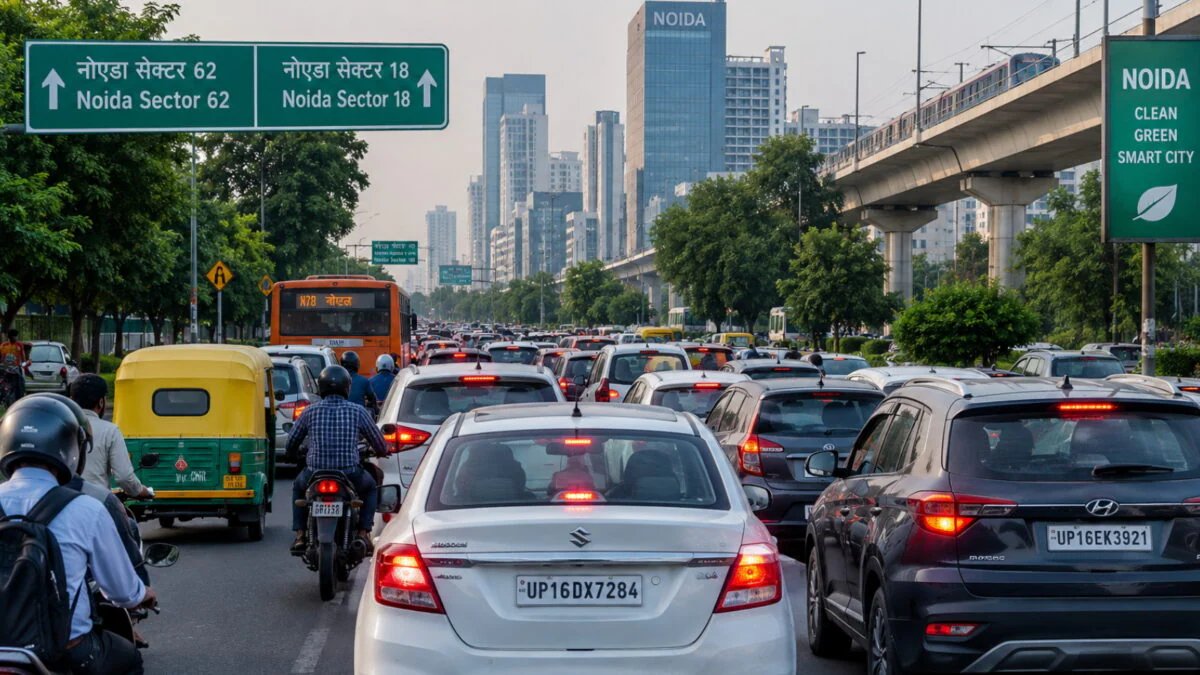
The expert committee has given comprehensive recommendations regarding pollution control in Delhi-NCR. Now, instead of being limited to only old BS-4 or earlier vehicles, a roadmap has been prepared to remove BS-6 vehicles from the roads in a phased manner. Two-wheelers are proposed to be phased out by 2035 and cars by 2040. After this, only electric vehicles will be registered.


The committee has submitted an interim report to CAQM in which it has been advised to impose a temporary ban on BS-4 vehicles from this winter. The pilot project may begin in the winter of 2026 and it is suggested that they be completely phased out by 2030. It has been recommended to immediately remove BS-1 to BS-3 vehicles. Also, only electric autos will be registered in Delhi from 2027.
BS-6 vehicles will also be discontinued
The expert committee has clarified that preparations to reduce pollution will no longer be limited to old vehicles. It has been proposed to remove BS-6 two-wheelers from the roads by 2035 and cars by 2040. After this, registration of only electric vehicles will continue. The committee believes that BS-6 vehicles currently account for a large share in the total active vehicles, but their contribution to PM emissions is relatively low.
Ban on BS-4 and old vehicles
It has been recommended to impose a temporary ban on BS-4 vehicles from this winter. The interim report submitted to CAQM suggests running the pilot project between November 1 and January 31. It can be implemented widely from the winter of 2026 and BS-4 vehicles should be completely phased out by 2030. It has been advised to immediately remove BS-1 to BS-3 category vehicles.
There are approximately 2.21 crore active and fitness-exempt vehicles in NCR. Among these, the share of BS-6 is about 41 percent but their contribution in PM emissions is said to be only 7 percent. BS-1 to BS-3 vehicles constitute 19 percent of the number but contribute 30 percent of emissions. BS-4 vehicles are around 30 percent in number while their share in emissions is 74 percent.
Incentive for purchasing electric vehicles
The committee has suggested an incentive of Rs 50 thousand on e-auto, Rs 30 thousand on two-wheeler and up to Rs 1 lakh on electric taxi or private car. An additional discount of Rs 10,000 to Rs 1 lakh is proposed on scrapping an old car. There is a provision of incentive up to Rs 20 thousand for two-wheeler and Rs 40 thousand for three-wheeler on converting petrol-diesel vehicles into EV. It has also been suggested to enact a ‘Right to Charge’ law so that in societies and office complexes without allocated parking, there is a provision for shared charging on at least 20 percent of the parking.
Electrification of government and municipal vehicles
From April 1, 2027, it is suggested that vehicles purchased or rented in government offices should have zero emissions. It has been proposed to make all municipal vehicles electric by 2030. It is recommended to electrify construction equipment by 2028 and heavy mining and earth-moving machinery by 2030. It has also been advised to promote vacuum cleaning and water sprinkling for road dust, ban on burning of garbage, fencing of construction sites and CBG plants for electric heating and waste management in industries.
Registration of only electric autos and LGVs from 2027
In Delhi, from January 1, 2027, registration of autos and light goods vehicles (LGV) up to 3.5 tonnes should be made only electric. It is recommended to implement these rules in the entire NCR also. Only electric auto registration is proposed in Gurugram, Faridabad, Sonipat, Ghaziabad and Gautam Buddha Nagar from January 1, 2028. In the rest of NCR, it has been advised to implement this system from January 1, 2029.
A separate deadline has also been set for LGVs of 3.5 to 7.5 tonnes. There is a proposal for electric registration for them in Delhi from January 1, 2028. It is recommended to implement this rule in high vehicle density districts from July 1, 2028 and in the rest of NCR from January 1, 2029.
After CNG now emphasis on EV
The committee says that CNG has helped in reducing pollution compared to diesel, but continuing the registration of CNG autos is not in line with the goal of clean transportation in the long run. The share of electric vehicles in the auto market is increasing rapidly. Their share in new sales is about 2.2 percent, yet their share in PM 2.5 emissions from new sales is about 19 percent.
This share in Delhi is about 37 percent. The committee estimates that by making new autos completely electric, about 5.5 tonnes of PM 2.5 emissions can be reduced every year. In case of light goods trains, it is suggested to remove diesel trains first. According to the report, diesel LGVs cause almost twice the pollution as CNG LGVs.