Context: Bengaluru-born astronomer Dr. Ramya Anche has been selected as Principal Investigator of NASA’s $20-million PUFFINS space telescope mission, marking a significant achievement for an Indian-origin scientist.
Also Read




About The PUFFINS Telescope Mission:
What it is?
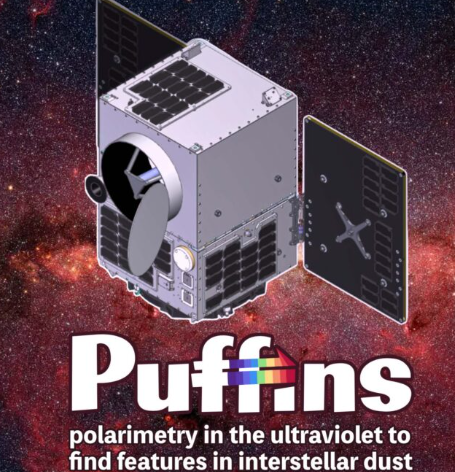
- PUFFINS (Polarimetry in the Ultraviolet to Find Features in INterStellar dust) is a low-Earth orbit small satellite (SmallSat) mission hosting a specialized 10-inch ultraviolet space telescope designed to observe and measure the polarization of UV starlight passing through the interstellar medium.
Organisation: Funded by NASA’s Astrophysics Pioneers programme, PUFFINS is led by the University of Arizona’s Steward Observatory, in collaboration with the McDonald Observatory, University of Texas.
Aim: To investigate the composition, structure, and magnetic alignment of interstellar dust grains, understanding their influence on the formation and evolution of stars and planets.
Key Features of PUFFINS:
- Space-Based UV Spectropolarimetry: Revives ultraviolet spectropolarimetry after nearly three decades, measuring the polarisation of starlight across different UV wavelengths to study interstellar dust properties.
- Studying Nanometre-Sized Dust Grains: Targets interstellar dust particles smaller than 50 nanometres, which are difficult to characterise using conventional optical and infrared observations.
- Mapping Interstellar Magnetic Fields: Examines how elongated dust grains align with the Milky Way’s magnetic field, using changes in starlight polarisation to investigate galactic magnetic structures.
- Observing Diverse Galactic Environments: Plans to study at least 70 distant stars across stellar nurseries, reflection nebulae, and the Magellanic Clouds to examine dust behaviour.
- Ground-Based Observational Support: Combines space-based ultraviolet measurements with observations from the 82-inch Otto Struve Telescope at McDonald Observatory to analyse surrounding interstellar gas.
Significance:
- Investigates interstellar polarisation, discovered in 1949, to clarify how dust influences galactic temperature regulation, chemical evolution, and star formation.
- Serves as a scientific precursor to NASA’s proposed Habitable Worlds Observatory (HWO), helping refine ultraviolet polarimetry technologies and future observational capabilities.