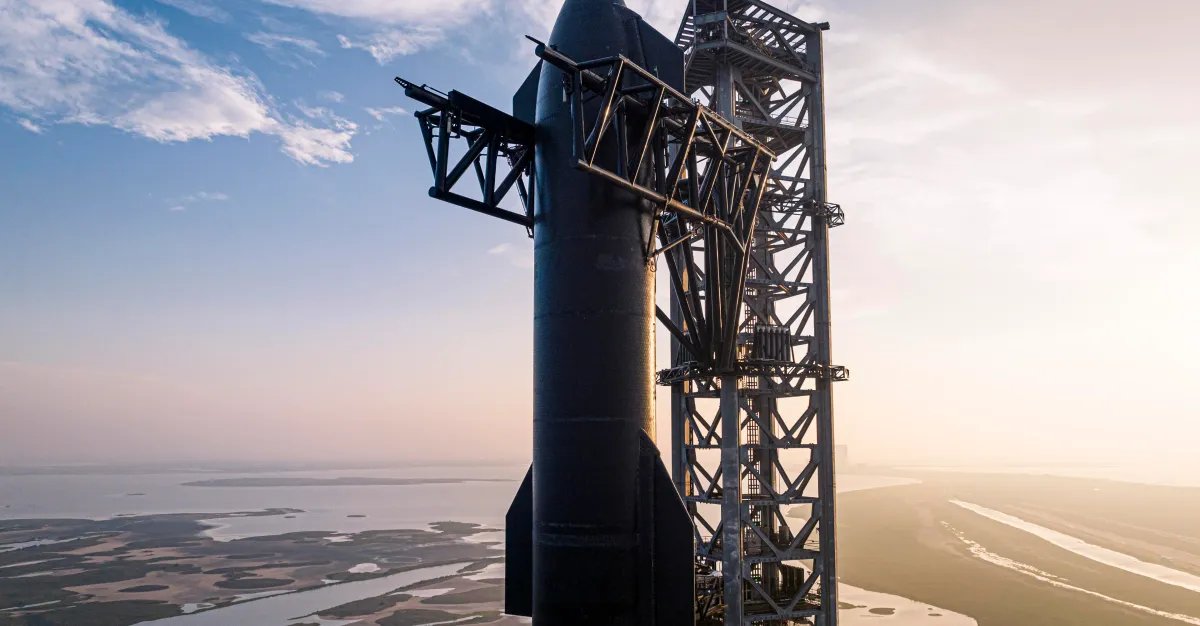
SpaceX CEO Elon Musk said the company would attempt to catch Starship and its booster next month, with the goal of recovering the entire orbital launch system for the first time. If successful, Musk said, the attempt would mark the first time in history an orbital launch vehicle has been fully recovered.



But he also allowed for the possibility of a failure. “Success is not guaranteed on these first flights, but I’d say it’s more likely than not that this succeeds next flight,” Musk said. “And if not, we have a steady stream of Starship flight attempts through the end of this year and then accelerating next year.”
“Success is not guaranteed on these first flights, but I’d say it’s more likely than not that this succeeds next flight.”
— Elon Musk
Starship is a two-stage system, composed of the Super Heavy booster (first stage) and the Starship spacecraft (second stage). It stands approximately 120 meters (around 400 feet) tall with a 9-meter diameter, and is powered by SpaceX’s Raptor engines burning liquid methane and liquid oxygen. Starship, which was first introduced in 2018, was designed to return to the launch site, where launch towers with mechanical “chopstick” arms catch the vehicle mid-air.
Last month’s Starship launch represented two firsts for its next gen rocket: send the spacecraft into Earth orbit, and insert a few dozen of SpaceX’s larger and more capable V3 satellites into the Starlink constellation for the first time. Still, the launch wasn’t without its snafus: one Raptor engine shut down prematurely during ascent, prompting mission control to adapt and complete the climb on remaining. Because of the issue, SpaceX cut the planned 10-hour, 6-orbit mission short after about 3 hours and 2 Earth orbits.
The Super Heavy booster splashed down in the Gulf of Mexico, while the Starship upper stage executed a de-orbit burn and ended with a fiery vertical splashdown in the Pacific Ocean north of Hawaii. Neither piece was recovered.