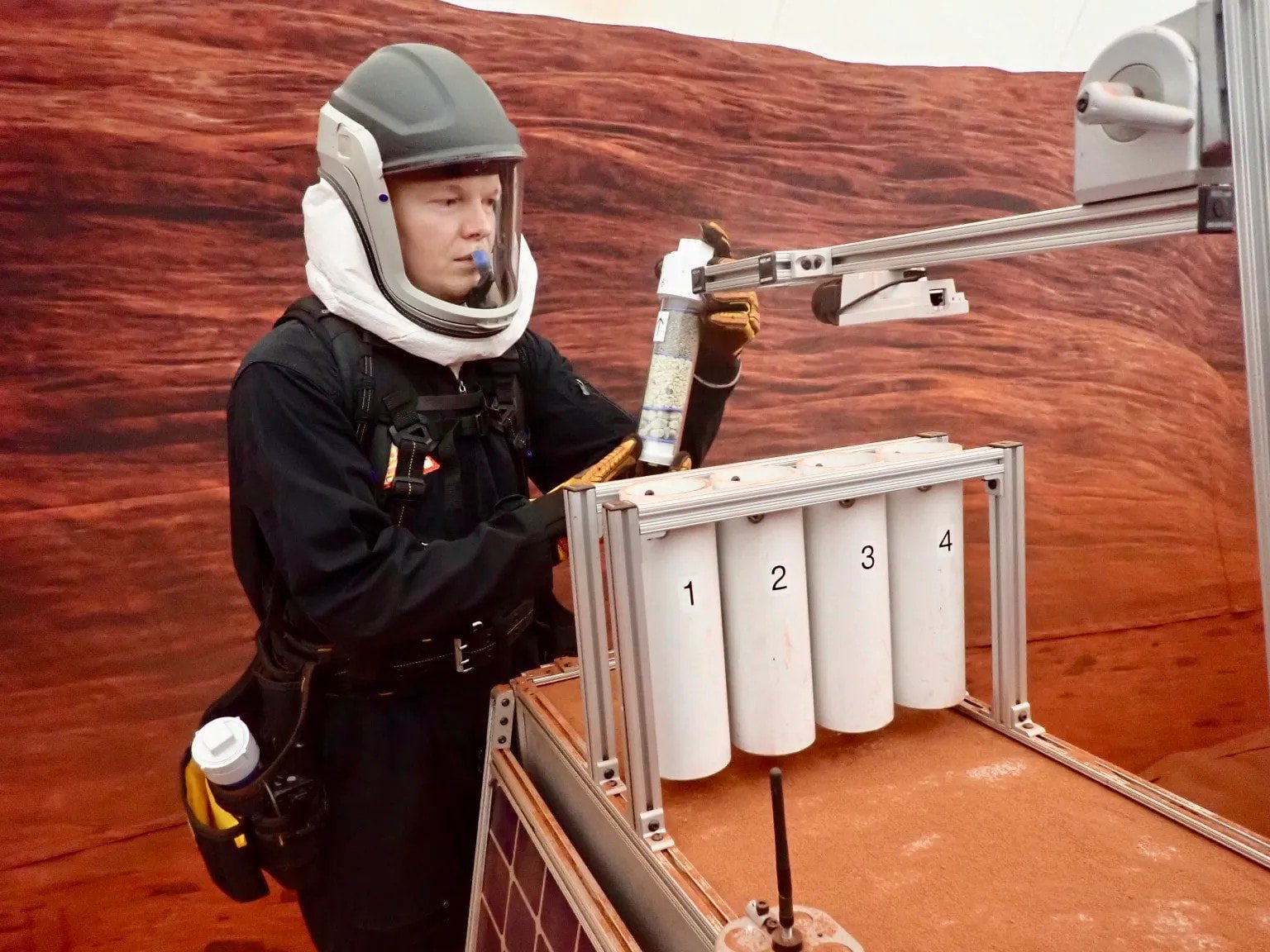
On October 19, 2025, American space agency NASA locked up four people inside a 3D-printed habitat located at the Johnson Space Center in Houston, Texas. More than a year later, the crew is preparing to come back to civilization.

The moment marks the end of the second of three Mars simulation missions, and another step taken toward a better understanding of what a crewed mission to the Red Planet will require. The first one, performed by Kelly Haston, Ross Brockwell, Nathan Jones, and Anca Selariu, ended in July 2024, after 378 days of isolation.
The crew of the second mission comprises Ross Elder, Ellen Ellis, Matthew Montgomery, and James Spicer. The four people stepped inside the so-called Crew Health and Performance Exploration Analog (CHAPEA) facility, tasked with pretty much the same things as their predecessors.
CHAPEA, a 1,700-square-foot habitat created by a company called ICON, is also called Mars Duna Alpha, and is described as the highest-fidelity simulated habitat our species has ever constructed.
Its role is to completely isolate groups of people from the outside world for long periods of time, with the goal of informing NASA on what it would take for a long-duration mission to another world to succeed.
The second CHAPEA crew spent the past year doing all the things Mars astronauts would have to do, including doing science, performing Mars walks, making ends meet with limited resources, growing crops, and coping with communication delays of up to 45 minutes each way.
When they come out at the end of the month, the crew will have spent 378 days inside. Soon after, NASA will conduct a two-week-long post-mission evaluation and debrief program, trying to gather as much data as possible on the experience, but also on crew health and performance.
The CHAPEA program was first announced back in 2021, and it is supposed to be three missions long. It’s not clear at this time when the next group of four people will go inside the facility for the final year-long mission.
If by chance you intend to be a part of that, keep in mind that there are certain conditions that must be met. They include being a U.S. citizen or permanent resident aged between 30 and 55 years old, healthy, and non-smoking.
When it comes to skills and qualifications, NASA requires a master’s degree from an accredited institution in a STEM field, two or more years of professional experience in a STEM field, or, in its place, at least 1,000 hours as pilot-in-command on jet aircraft.
CHAPEA is not the only habitat designed to simulate living conditions on other worlds. For years, people have been going to Antarctica or the International Space Station (ISS) to do that, or they’ve entered another facility located at the Johnson Space Center: the Human Exploration Research Analog (HERA). Even the European Space Agency (ESA) has one, the Future Lunar Exploration Habitat (FLEXHab).