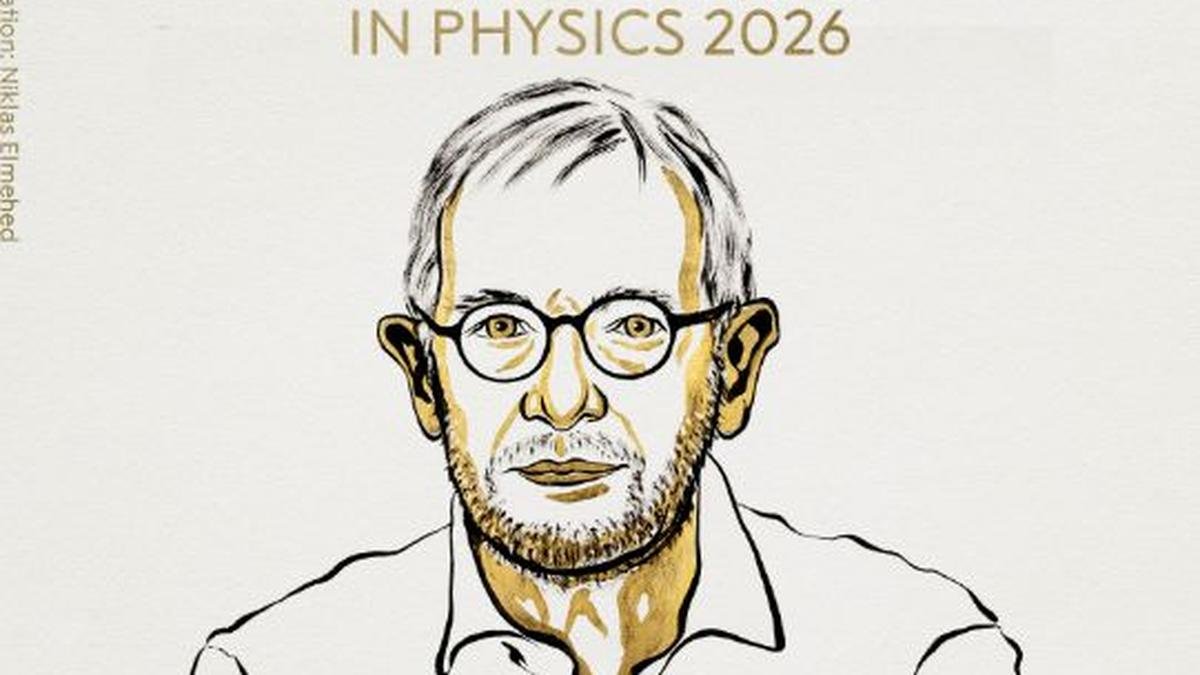

The 2026 Nobel Prize in Physics has been awarded to Francis Halzen “for decisive contributions to the IceCube Neutrino Observatory and the discovery of high-energy neutrinos of astrophysical origin”. Image courtesy: @NobelPrize / Illustration: Niklas Elmehed


The Nobel Prize in Physics for 2026 has been awarded to Francis Halzen “for decisive contributions to the IceCube Neutrino Observatory and the discovery of high-energy neutrinos of astrophysical origin.”, the Royal Swedish Academy of Sciences said.
The IceCube Neutrino Observatory – ideated by this year’s physics laureate Francis Halzen – tracks neutrinos that originate in the distant cosmos.
The neutrino interactions that are continuously collected by IceCube will provide researchers with novel knowledge about the violent settings in which high-energy neutrinos can be created – and could even reveal previously unknown cosmic phenomena.

Cosmic neutrinos with extremely high energies are very rare, so an enormous volume of ice is needed to observe an adequate number of collisions. The IceCube Neutrino Observatory covers an entire cubic kilometre and was finished in 2011. Researchers soon discovered the first high-energy neutrinos and, a few years later, could publish their discovery of neutrinos that must originate far outside our solar system. The search for the universe’s neutrino sources could begin in earnest.
Francis Halzen has laid the foundation for an entirely new type of astronomy. His idea was to use glacial ice at the South Pole to capture the secretive particles called neutrinos. The result was the IceCube Neutrino Observatory, which can track neutrinos that originate in the distant cosmos.
Born in 1944 Tienen, Belgium, Halzen is Professor at University of Wisconsin–Madison, USA.
It is a great pleasure to hear about this prize, said Halzen when the Committee reached out to him after the announcement.

Last year, John Clarke, Michel Devoret and John Martinis won the Physics Nobel for building device showing ‘quantum tunnelling’.
The announcement of medicine Nobel kicked off the Nobel announcement week. Karl Deisseroth, Peter Hegemann, and Georg Nagel have been awarded the 2026 Nobel Prize in Physiology or Medicine for discoveries leading to a technique called optogenetics, which allows scientists to control select nerve cells using light.
The Nobel Prize for chemistry will be announced on Wednesday (October 7), followed by literature (October 8), and peace (October 9). The Sveriges Riksbank Prize in Economic Sciences, popularly known as Economics Nobel will be announced on October 12.

The winners will get a cash award of 12 million Swedish kronor (about $1.2 million). The award will be presented on December 10, the Nobel Prize day, also the death anniversary of Swedish inventor Alfred Nobel, who in his will dictated that his estate should be used to fund “prizes to those who, during the preceding year, have conferred the greatest benefit to humankind”.
Published – October 06, 2026 03:21 pm IST