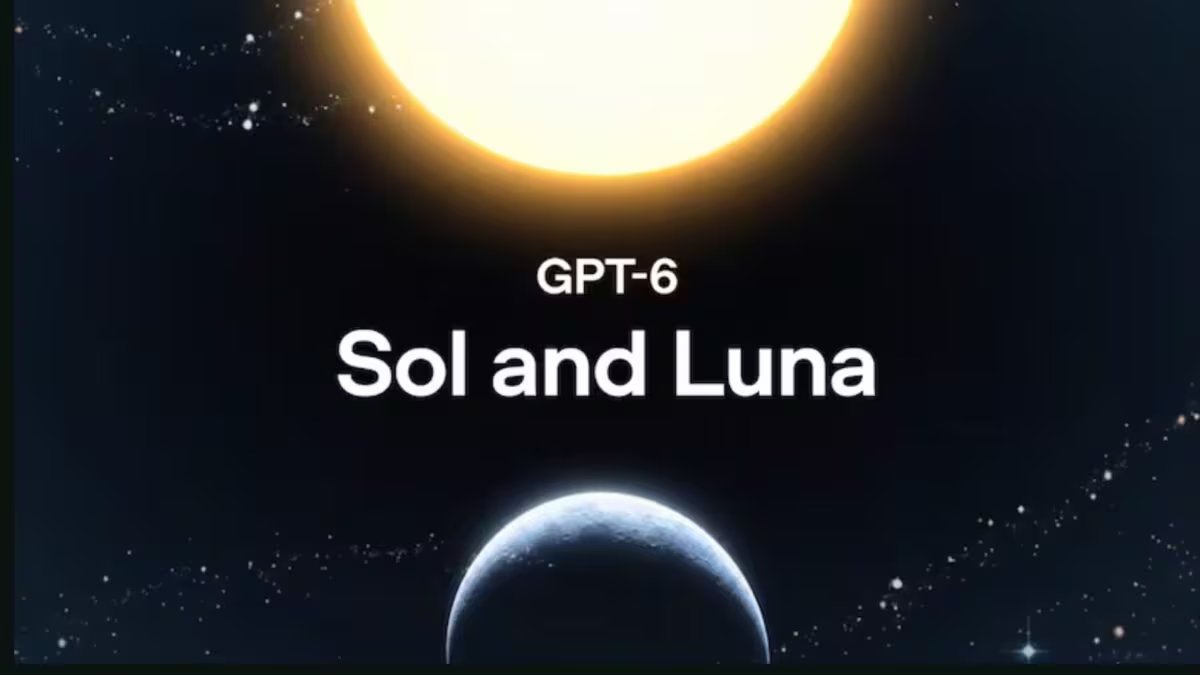
Expanding its new GPT-6 series, OpenAI has launched two new AI models GPT-6 Sol and GPT-6 Luna. Both models are designed to bring the capabilities of the recently introduced GPT-6 Astra technology into a low-cost option. According to OpenAI, Sol is designed for complex reasoning, coding, and agentic workflows, while Luna focuses on fast, large-scale, everyday tasks.



What is special about GPT-6 Sol and Luna? OpenAI says that the new models bring better factuality, coding and communication capabilities compared to its previous GPT-5.6 models. GPT-6 Sol is specifically designed for complex coding and agentic workflows. Whereas GPT-6 Luna is designed for high-volume tasks where low cost and fast processing matter more.
Both models support text and image input into the API and have a context window of 1.05 million tokens and a maximum capacity of 128,000 output tokens.
GPT-6 Sol and Luna Price
OpenAI has kept the API price of both models lower than the GPT-5.6 generation. The price of GPT-6 Sol is $2 for 1 million input tokens and $10 for output. Whereas the price of GPT-6 Luna is $0.10 for 1 million input tokens and $0.50 for output.
This means developers will get the option to use the new model at a lower cost, especially for large-scale AI workloads. According to OpenAI, the prices of Sol and Luna are 50 percent lower than the initial promotional prices of GPT-5.6.
Which users will get access?
GPT-6 Sol and GPT-6 Luna are available via API. According to OpenAI’s announcement, both models have been rolled out in ChatGPT Work and Codex for Plus, Pro, Business, Enterprise and Edu users. Free and Go users have been given the option to use GPT-6 Luna in the desktop app.
However, availability of these models may vary depending on the product. OpenAI has positioned Astra as the most capable model in the GPT-6 family, Sol as a balanced option for complex tasks, and Luna as the more efficient model.