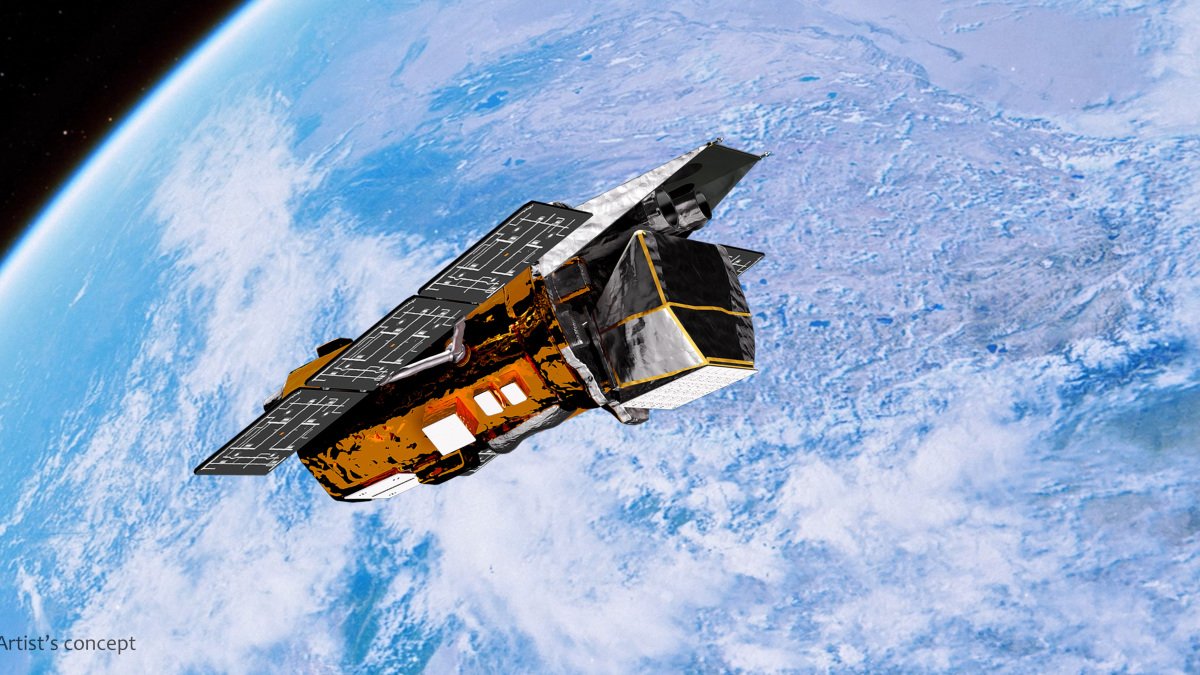
Swift diligently provided some of the most important astronomical observations for over 22 years.



Credit: NASA
It’s official: The Neil Gehrels Swift Observatory, which left Earth on November 20, 2004, returned to it on November 4, 2026. What’s left of the spacecraft has now touched down, though only micro-particles will have survived the heat of reentry.
Last year, with Swift experiencing steep orbital degradation and time quickly running out, NASA agreed to let a private plane-boosted rocket attempt to push the observatory back into a sustainable orbit. Katalyst Space Technologies’ LINK spacecraft launched on June 27, 2026, and very quickly experienced two reaction wheel failures, causing it to spin out of control. Despite a valiant effort to correct LINK’s journey, the rendezvous mission failed, and all hope of saving Swift was lost.
It’s true that Swift could potentially have lived longer, but 22 years is still a very long and respectable run. In that time, Swift was one of the most scientifically productive satellites ever launched.
A lot of the credit goes to its fundamental design, which prioritized rapid response. This meant Swift could observe events that could only be predicted a short time in advance, or even those that could only be pinpointed after they had already begun. In fact, Swift was semi-autonomous, meaning that it could react even faster than human observation could allow.
Within certain limits, Swift could choose and observe its targets so as to maximize its scientific output.

Neil Gehrels poses in front of his eponymous observatory, just finished in 2003.
Credit: NASA
A lot of the credit also goes to its scientific instruments. Swift had three main instruments: One for detecting gamma-ray bursts, one for detecting X-rays, and one for detecting visible/UV light. This made it a comprehensive observatory that could study the same event in multiple ways. For the most part, the X-ray and visible light instruments were intended to observe the afterglow of gamma-ray burst events.
Swift’s main contribution was a much more exhaustive understanding of the origins of short gamma-ray bursts. It studied thousands of such events and, overall, was able to pinpoint their origins largely to binary systems. Binary neutron star systems are now thought to be the main source of short gamma-ray bursts; this is distinct from longer-term gamma-ray emissions, which mostly originate from the collapse of stars into black holes.
These gamma-ray bursts can be studied from extreme distances, and so from extreme time differences as well. Swift helped astronomers study the early universe, using gamma-ray bursts as yardsticks.
Still, Swift’s most important legacy will likely be its impact on the future of space-based astronomy. Not only has it shown the need for rapid-response observatories that can capture every bit of data before it’s gone, but it has also validated the argument for singular, multi-wavelength observatories.
One reason Swift has been so useful is that it captured anything it saw across a wide breadth of wavelengths. That allowed cross-referencing different types of data without coordinating multiple satellites to view the same event at the same time.
Ultimately, while this year’s quest to save Swift ended in failure, the observatory was originally only scheduled to run for two years. It ended up running 11 times longer. Even as NASA looks to new instruments to take its place, Swift will be remembered for shifting astronomical paradigms.