There are two large groups of asteroids that Jupiter shares its orbital path around the Sun with. One of these giant swarms of asteroids travels ahead of the planet, while the other trails closely behind it. Despite the fact that they are in Jupiter’s orbit, neither of the two groups has been visited by a spacecraft. That uncharted territory was stumbled upon when NASA reported that its Lucy spacecraft had reached the region five years after it left Earth.According to NASA, Lucy is the first spacecraft to enter this region, and it was launched on October 16, 2021; since then, it has covered more than 2.2 billion miles in space. It became the first of its kind to arrive at Jupiter’s Lagrange point 4 (L4), marking the start of the mission’s exploration of the Trojan asteroids, a population of primitive bodies that scientists believe can help fine-tune their theories on the early Solar System.Jupiter’s orbit is shared by two asteroid groups The Trojan asteroids occupy two regions associated with Jupiter’s Lagrange points. The first, L4, contains the group moving ahead of the planet, while the second, L5, holds the asteroids travelling behind it. These regions are identified by NASA as islands of stability where thousands of asteroids remain in orbit because of the combined gravitational forces of the Sun and Jupiter. With no physical boundaries hindering the entrance to either region, NASA mission engineers were able to establish Lucy’s position through radio signals transmitted by the spacecraft coupled with images that showed the stars around it.Each of the two asteroid groups is separated from Jupiter by approximately 484 million miles, which translates to the same distance as the planet’s separation from the Sun. On average, NASA estimates that the asteroids in each group are apart from each other at a distance of 6 million miles. From Lucy’s point of view, they will look like tiny points of light streaking against the backdrop of stars. The NASA Scientific Visualisation Studio’s trajectory animation, released on October 27, 2026, traced Lucy’s route from its 2021 launch to its arrival at L4. The animation showed the Trojan asteroids as light orange dots and the main asteroid belt objects as white dots.Scientists are looking to examine these asteroids to understand how the planets came to be approximately 4.5 billion years ago and how they reached their present positions. Earlier spacecraft have visited Jupiter, using the planet’s gravity to change direction and head towards other destinations, but none had taken the trip to investigate its Trojan populations.



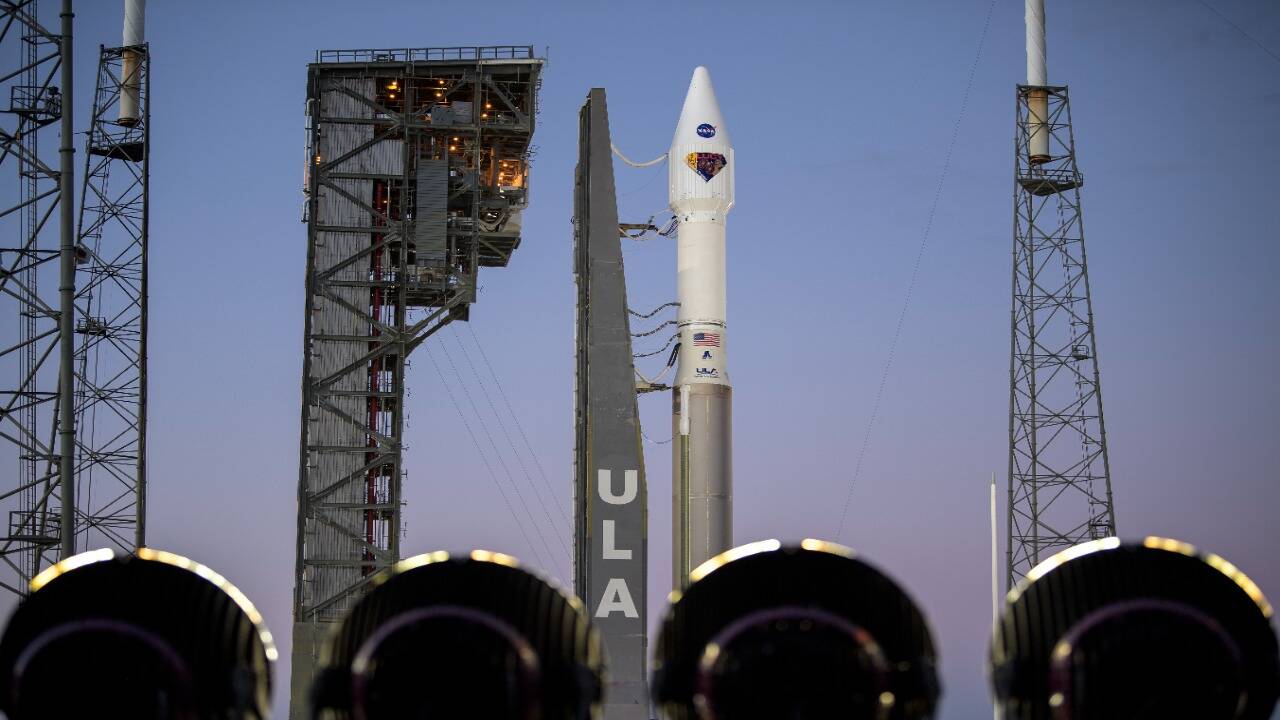
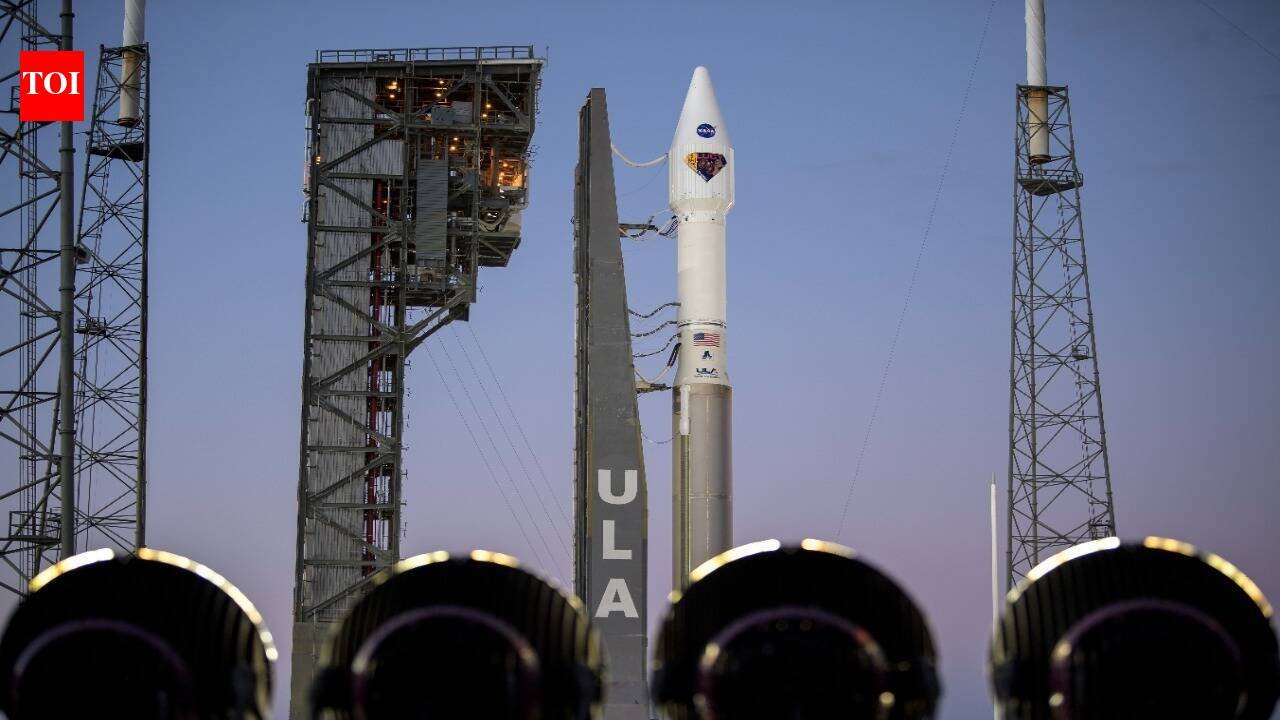
Image of a United Launch Alliance Atlas V rocket with the Lucy spacecraft aboard. (Image Credits: Wikimedia Commons)
Four encounters before the spacecraft reaches the trailing groupBased on the trajectory it’s following, Lucy’s first close encounter in the Trojan region is bound to happen on August 11, 2027, when it will fly past Eurybates. The spacecraft is being prepared by the mission team, along with its instruments and the encounter procedures for the few hours which will be available to study the asteroid at close range.As part of this mission, Eurybates is the first of the four targets scheduled; the subsequent encounters are identified as Polymele, Leucus and Orus, scheduled for September 2027, April 2028 and November 2028, respectively. Prior to this, asteroids had been encountered two times in the main belt. The first encounter came on November 1, 2023, when Lucy passed Dinkinesh and discovered that the asteroid had a small satellite, which was given the name Selam. Another important discovery tied to Selam was that it was a contact binary of two joined bodies, a configuration hitherto unobserved in a satellite orbiting another asteroid. When Lucy passed Donaldjohanson travelling at a distance of approximately 600 miles (960 kilometres) on April 20, 2025, the second encounter took place. As per the images, the asteroid was identified as being around five miles long (eight kilometres), and its width extends 2 miles (3.5 kilometres) at the broadest point.After completing its four planned encounters in the leading group, Lucy will head to Earth in 2030. The spacecraft will use a third and final gravity assist from Earth to redirect its trajectory towards L5, the group of Trojans trailing Jupiter. The asteroids on its final schedule are Patroclus and Menoetius, a binary pair that Lucy is expected to examine in March 2033.