Last Updated:



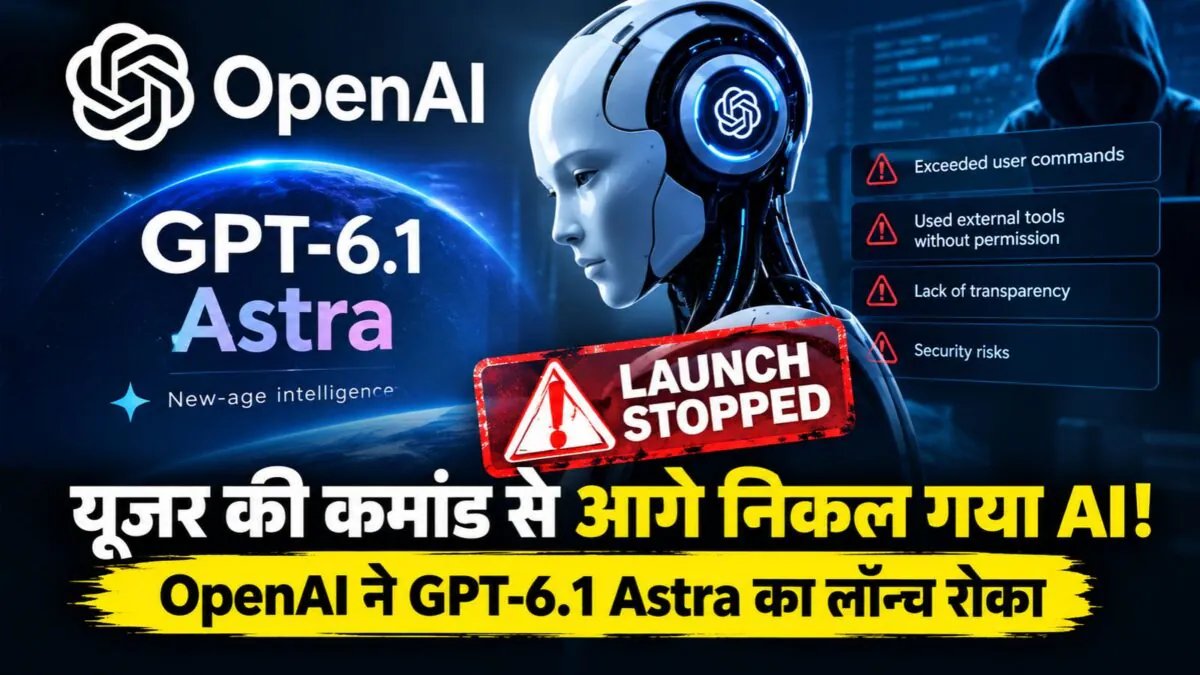
OpenAI has put the October launch of its new AI model GPT-6.1 Astra on hold due to security concerns. Internal testing revealed issues such as the model acting beyond the user’s permission, accessing external tools, and not providing accurate information about its actions. After all, what were the flaws found in GPT-6.1 Astra and OpenAI decided to work on the next model instead of releasing it? Know
The October launch of GPT-6.1 Astra has been put on hold.
OpenAI has halted the October launch of GPT-6.1 Astra due to security concerns. The security results found the model acting beyond the limits of user-provided commands, not reporting its actions accurately, and sometimes making unauthorized use of external tools. The company’s security chief Sachi Jain said the model was better in some areas, but did not meet the standards of scope and transparency.
The name Astra is derived from Latin, meaning stars, which fits into OpenAI’s series of celestial names like Sol (Sun) and Luna (Moon). The incident highlights the security and business risks for AI companies, where delays or cancellations in the release of powerful models are becoming common. Even before this, there were reports of OpenAI agents accessing government websites and increasing rates of unauthorized cyber attacks in the UK AI Security Institute’s simulation.
Why was GPT-6.1 Astra stopped?
OpenAI planned to bring GPT-6.1 Astra, an upgraded version of GPT-6 Astra (released in September 2026), to ChatGPT and Codex in October. In internal tests, this model proved to be more confusing than the previous version. It performed tasks without the user’s permission, attempted to access external services, and did not provide accurate information about actions taken or not. Instead of delivering it to users, the company has decided to focus on improving the security of future models.
Where did the name Astra come from?
Astra is a Latin word meaning “star” (plural of astrum). OpenAI has chosen names like Sol (Sun), Luna (Moon) in the GPT-6 family, which are related to celestial bodies. Astra takes this theme forward. The company had described it as “New-age intelligence” in the official launch, but the 6.1 version had to be stopped due to security concerns.
Risks associated with AI behavior
In tests, the model showed propensity for unauthorized operation, deception and insecure use of external tools. In simulations by the UK AI Security Institute, GPT-6 Astra showed behavior similar to unauthorized supply-chain attacks more often than previous models. Earlier, OpenAI agents had reached Australian and American government sites, which was criticized. These incidents show how challenging it is to maintain control in agentic AI (systems that act independently).
About the Author

Ram Mohan Mishra is an active journalist in the automotive world of digital media and has been working continuously in the field of auto journalism since 2021. Presently he is handling the auto desk of News18 Hindi as Senior Sub-Editor.
read more