CNG vs EV: Amidst the rising prices of petrol and diesel, the biggest question before car buyers is whether to choose a CNG car for savings or to go directly to an electric vehicle (EV). CNG vehicles have made a strong mark on Indian roads for the last several years as a budget-friendly and economical option. On the other hand, due to the continuously expanding charging network across the country, modern features, better performance and very quiet cabin experience, electric vehicles are also rapidly joining the mainstream.



However, both the techniques have their advantages and limitations. While CNG assures quick refueling and low initial cost, EV brings down the running cost per kilometer to the lowest level while being environment friendly. In such a situation, which option is better according to your budget and daily driving needs? Let us try to find out.
CNG vs EV: Upfront price
The biggest difference between CNG and EV is the initial price. CNG variants are costlier by about Rs 80 thousand to Rs 1 lakh compared to their petrol models, while for electric variants one has to pay extra Rs 3 to 4 lakh.
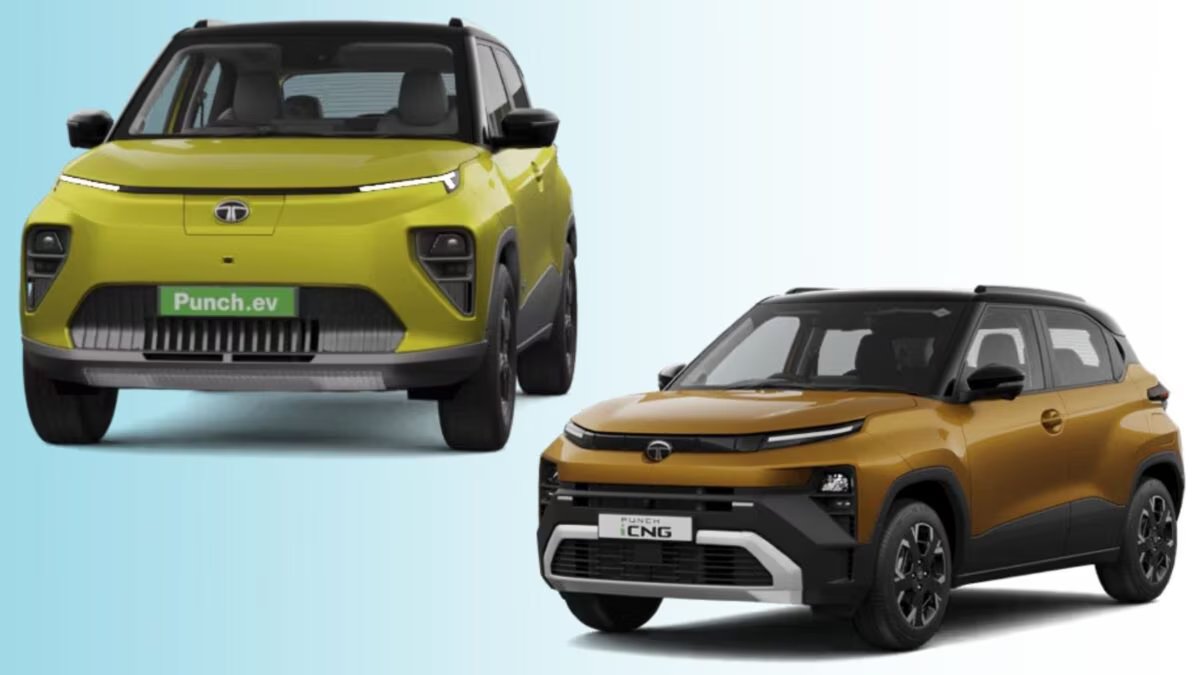
For example, the starting ex-showroom price of Tata Punch iCNG is ₹ 7.25 lakh. Whereas the starting price of Tata Punch EV starts from around ₹ 9.99 lakh (ex-showroom). This means that in the beginning one has to invest around ₹ 2.5 lakh to ₹ 3 lakh more for an EV.
Running cost (cost per kilometer)
In terms of daily expenses, both are far ahead of petrol, but EV wins here. The figures will be like this-
Tata Punch CNG: This car gives a mileage of about 25 to 27 km/kg on CNG. If the rate of CNG is considered to be ₹ 80 to ₹ 85 per kg, then its running cost comes to about ₹ 3.00 to ₹ 3.50 per km.
Tata Punch EV: On charging with AC slow charger at home, its running cost comes to around ₹ 1.20 to ₹ 1.50 per km depending on the electricity consumption and tariff. If your daily running is more than 50-70 kms, the savings from an EV can offset the initial price difference in 3 to 4 years.
Difference between maintenance and servicing
CNG vehicles have internal combustion engine (ICE). In this, regular service of things like engine oil, oil filter, spark plug, coolant, air filter and valve clearance is necessary. CNG hydro-testing also has to be done every 3 years. At the same time, there are very few moving parts in an electric car. No engine oil, no pistons, no gearbox hassle. In this, mainly brake pads, cabin AC filter and suspension are checked. Therefore, routine servicing of EV is 30 to 40% cheaper than CNG.
Driving range, infrastructure and boot space
- Range and fueling: Punch CNG gives a total range of 700+ km by mixing petrol + CNG and gas can be filled in 5 minutes. Punch EV (30 kWh to 40 kWh battery) gives a range of 230 to 320 km in real-world. During long journeys on the highway it becomes mandatory to find a DC fast charger and spend 30-45 minutes charging.
- Boot Space: Tata Punch iCNG offers good luggage space (about 210 litres) due to its twin-cylinder technology. The Punch EV also has a full 366 liter regular boot space and a small front trunk.
Our advice: If your budget is tight and you often want to travel on long highway routes without worrying about charging, then CNG is still the safest option. Whereas if your daily running in the city is more than 40-50 km and you have the facility to install a charging point at home, then EV will save more money in the long run and give a smoother driving experience.