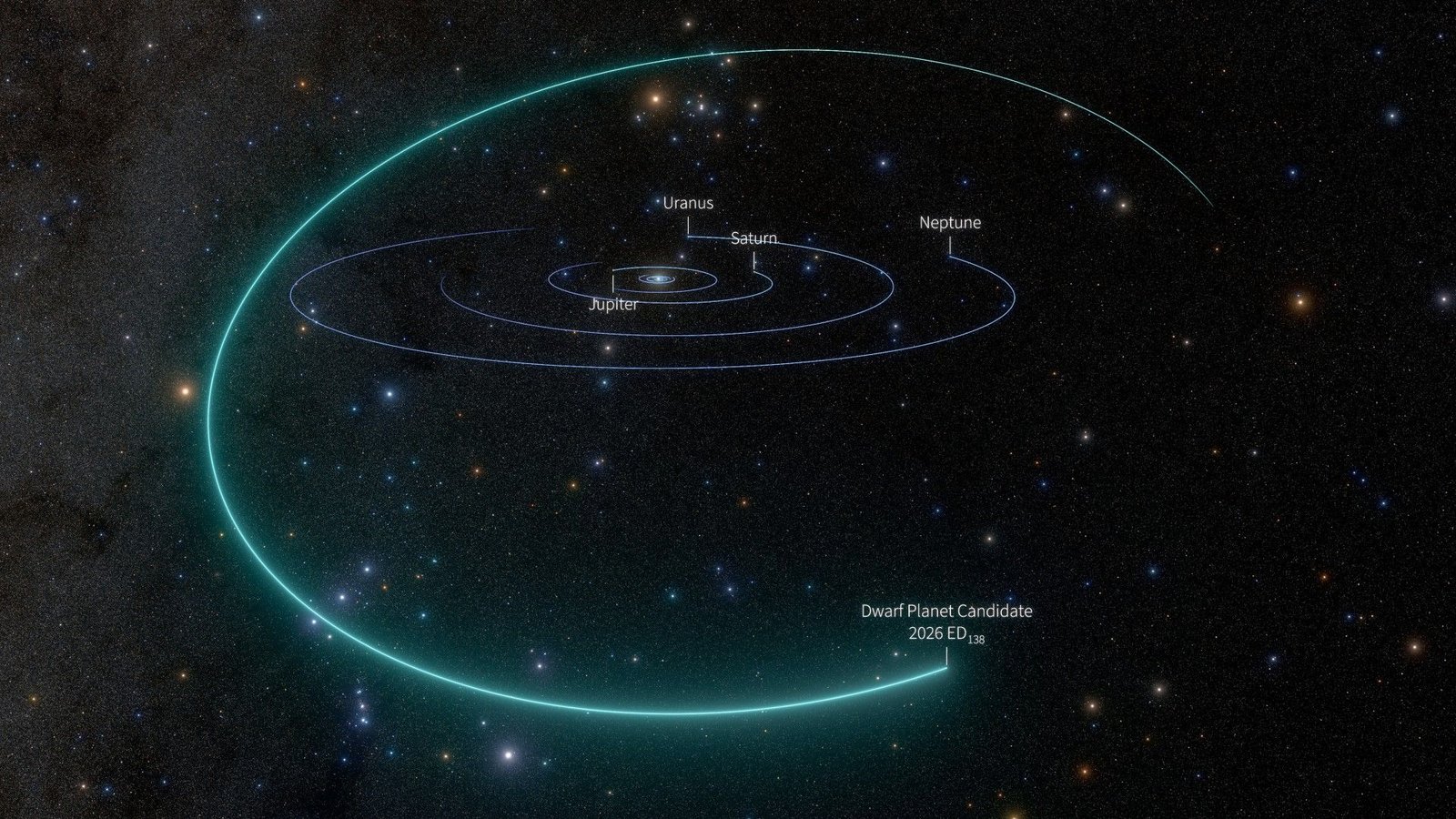



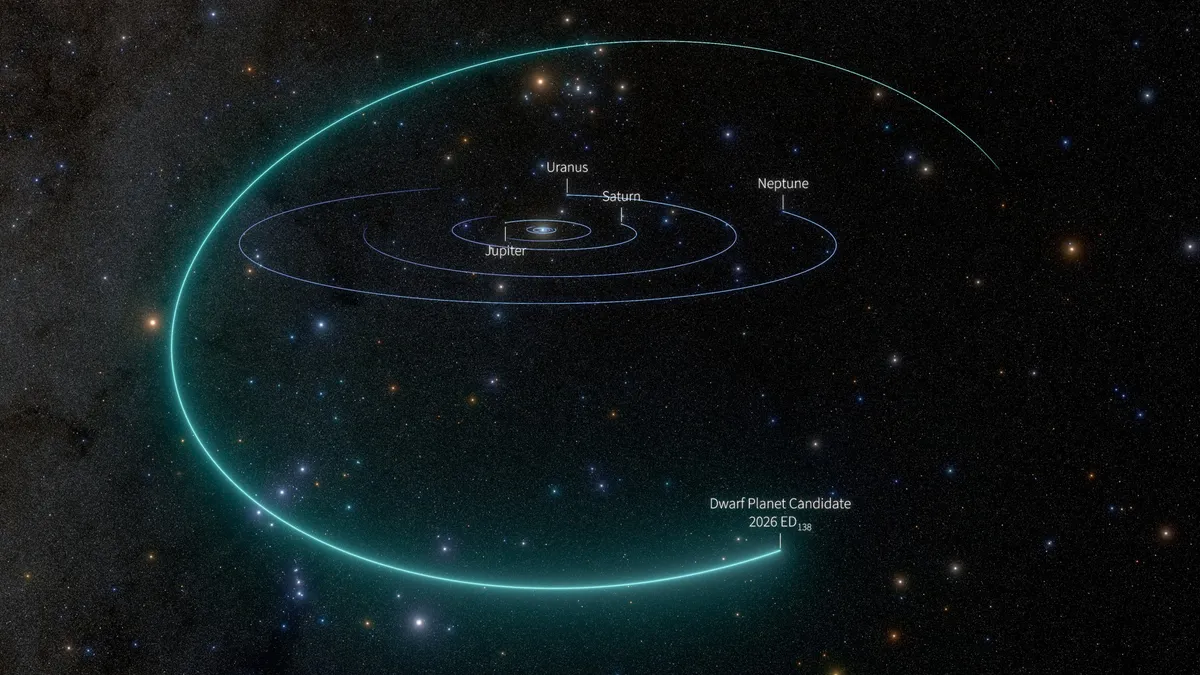
The powerful Vera Rubin Observatory has spotted what seems to be a dwarf planet circling the sun in the frigid depths beyond Neptune.
The icy object, known as 2026 ED138, is likely between 600 and 1500 kilometers (373 to 972 miles) wide, scientists say. It’s therefore probably big enough to be sculpted into a sphere by its own gravity — a key characteristic that separates dwarf planets from asteroids and other small space rocks.
And if 2026 ED138 is indeed a dwarf planet, that’s a pretty big deal, as astronomers have confirmed just five of them to date: Pluto, Ceres, Eris, Haumea and Makemake.
2026 ED138 was discovered by Matthew Holman, who works at the Center for Astrophysics | Harvard & Smithsonian (CfA). The big moment came on Oct. 13, when Holman was running previously collected Rubin data through a search code that he developed with his CfA colleague Kevin Napier.
That search revealed a mysterious object beyond Neptune‘s orbit. Despite its immense distance from the sun, this body was relatively bright, suggesting that it’s larger than the average trans-Neptunian object.
“My first reaction was one of excited disbelief,” Holman said in a statement on Tuesday (Oct. 27), the day the discovery of 2026 ED138 was announced. “Objects like this are very rare, so I immediately started checking whether I or the code had done something wrong.”
Those checks involved a thorough search through Rubin’s catalog. And that catalog is pretty heft, even though Rubin is a pretty new scope.
The Vera Rubin Observatory sits atop Cerro Pachón, an 8,799-foot-tall (2,682 meters) mountain in northern Chile, and features a primary mirror 28 feet (8.4 m) wide. The scope achieved first light in April 2025 and began its main project, the 10-year-long Legacy Survey of Space and Time (LSST), in June of this year.
During the LSST, Rubin images the entire southern sky every few days using a 3.2-gigapixel camera, the largest digital camera ever built for astronomy. This work creates a high-resolution time-lapse “movie” that can reveal a great deal about the cosmos.
For example, astronomers think Rubin will shed light on dark energy and dark matter, the mysterious stuff that together makes up most of the universe’s mass-energy budget. Its observations will also serve as a solar system inventory, helping scientists map out our cosmic backyard like never before. Rubin has already discovered more than 11,000 new asteroids, for example, with many more surely to come.
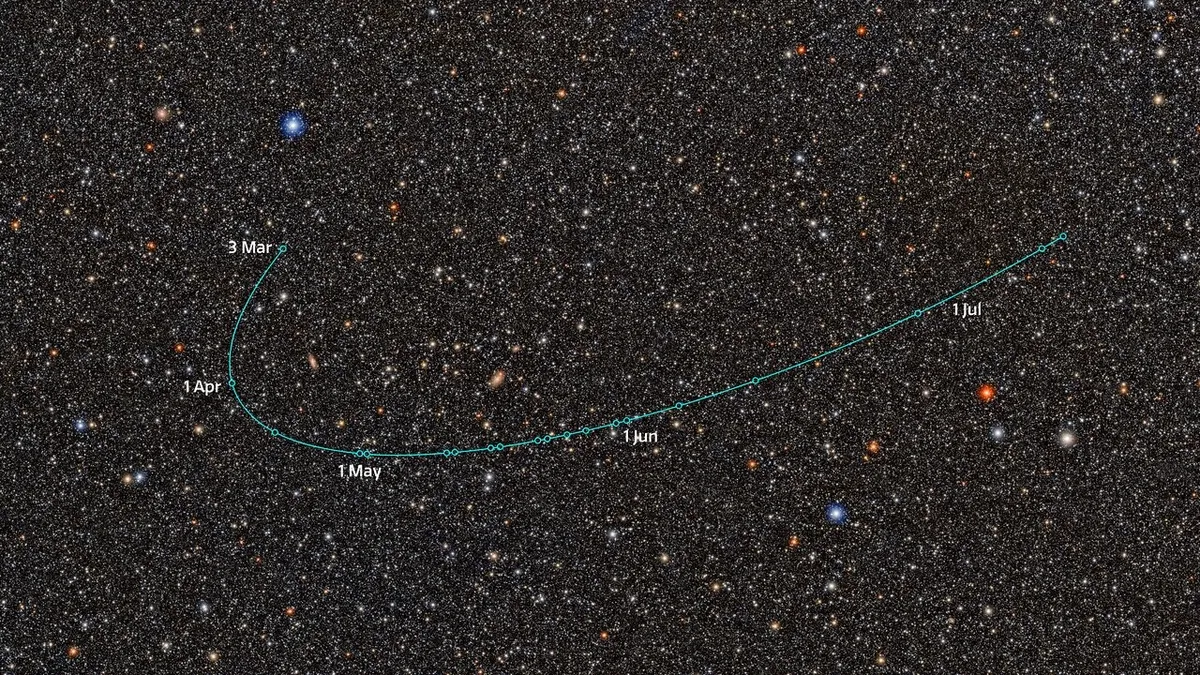
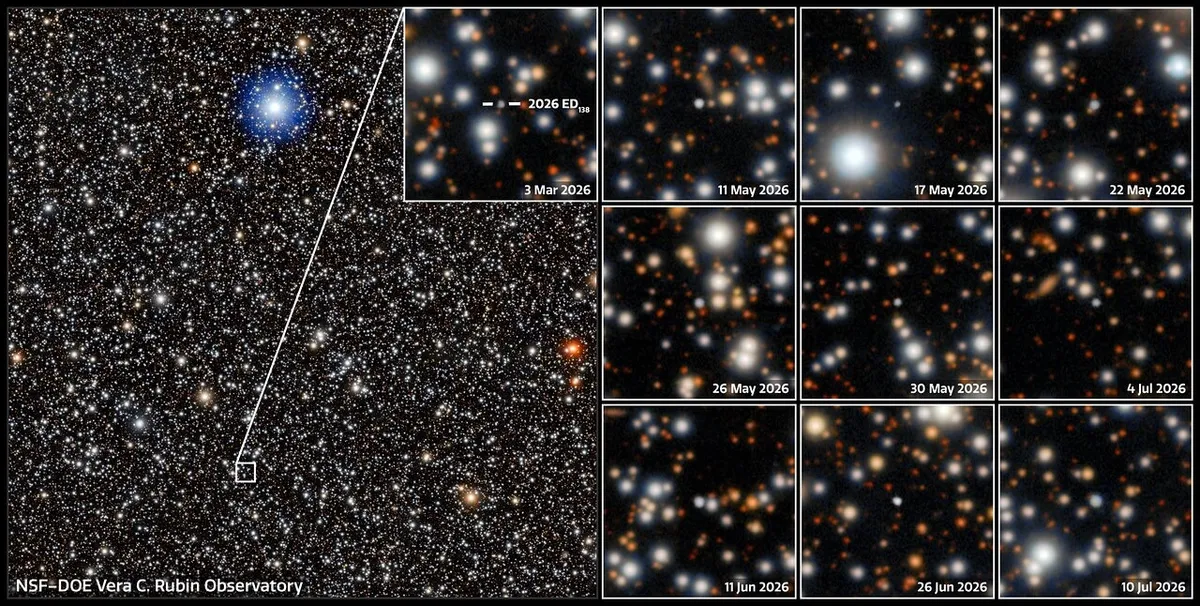
The LSST inventory will likely include a number of new dwarf planets as well — including, possibly, 2026 ED138. For the object definitely exists: Holman and his colleague Mario Jurić, who works at the University of Washington and serves as Rubin Solar System Lead Scientist, found that Rubin spotted 2026 ED138 30 separate times on 20 nights between March 4 and July 11 of this year.
And further digging revealed that the Dark Energy Camera (DEC), an instrument on the Víctor M. Blanco 4-meter Telescope at the Cerro Tololo Inter-American Observatory in Chile, also spotted 2026 ED138. Indeed, DEC observations of the object go all the way back to 2016.
The data show that 2026 ED138’s orbit is tilted by about 25 degrees relative to the plane of the solar system. It therefore likely had a gravitational interaction with Neptune, which knocked it off kilter, scientists say.
2026 ED138 currently lies about 46 astronomical units (AU) from the sun. (One AU is the Earth-sun distance — about 93 million miles, or 150 million kilometers). This puts it beyond Pluto’s average distance from the sun, which is roughly 40 AU.
There is still much to learn about the object, however. For example, we won’t know whether or not it’s a dwarf planet until astronomers nail down its size. And that will require observations in infrared light, the range of wavelengths that NASA’s James Webb Space Telescope is optimized for.
So stay tuned: There’s doubtless more news about 2026 ED138 coming, and Rubin could turn up more worlds like it in the coming months and years.
“If confirmed as a dwarf planet, ED138 would join a very small family of worlds,” Holman said. “Rubin will image the whole southern sky again and again for 10 years, so any others hiding in the places earlier surveys skipped are now within reach.”