Last Updated:



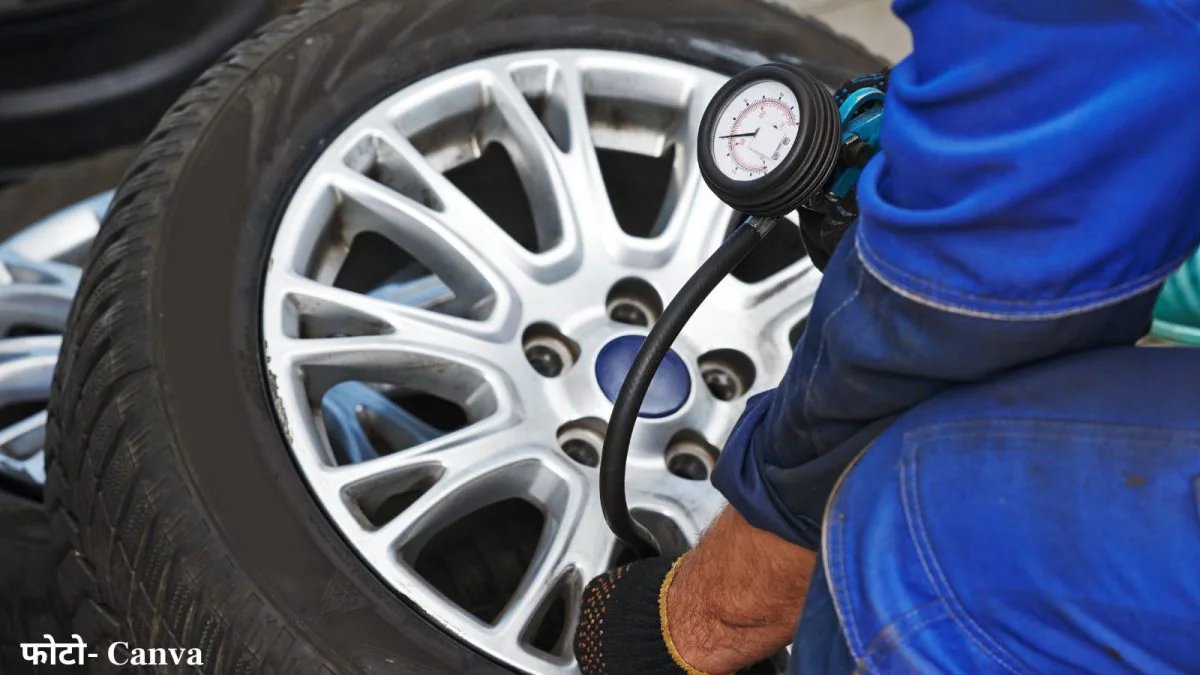
Filling more or less air in the car tires can be heavy on both your pocket and safety. Incorrect tire pressure can lead to reduced mileage, early tire wear and increased discomfort during long journeys. But how much air should be in the tires of hatchbacks, sedans and SUVs? Where is the correct PSI written and what is the right time to check the air pressure? Know everything.
How much air to fill in a car tire? Know
How much air should be in a car’s tyre: Maintaining correct tire air pressure is most important in routine car care, yet people often ignore it. Proper tire air not only improves the balance and driving comfort of the vehicle, but it is also very important for your safety. If the air pressure in the tire is correct as per company standards, then there is no unnecessary pressure on the engine, due to which the mileage of the vehicle improves significantly.
On the contrary, incorrect air pressure rapidly reduces the life of the tire and increases the risk of accidents like tire blowout on the road. Every vehicle manufacturer sets a specific air pressure according to the weight, model and size of the wheels of its car. Therefore, it is important for every driver to know the correct tire pressure for safe travel, better grip and fuel savings. Let us know what the air pressure should be in the car.
standard air pressure
Standard tire pressure for most passenger cars is between 30 to 35 PSI (Pounds per Square Inch). However, it may vary slightly depending on the segment. Broadly speaking these parameters are followed-
- hatchback car (like Swift, i10): 30 to 32 PSI
- Sedan car (like City, Verna): 32 to 33 PSI
- Compact and full-size SUVs (like Creta, Scorpio): 33 to 35 PSI
If the car is filled to capacity with passengers and heavy luggage, it is recommended to have 1–2 PSI of extra air in the rear tires.
Where to check the exact pressure?
Instead of relying on the internet or the estimates of petrol pump employees, it is important to look at the exact figures given by the company. You will get this information at the following places-
- On the sticker on the driver’s side door frame (B-pillar)
- On the inner side of the fuel lid (petrol tank lid)
- In the car’s owner’s manual
less/more air loss
Many types of problems arise when there is unbalanced air in the tyre-
- Under-inflation: The outer edges of the tire wear out faster, mileage is reduced, steering feels heavy and there is a fear of the tire bursting due to overheating.
- Over-inflation: Tires wear out from the middle, grip on the road is poor, ride feels overly harsh and the suspension jerks over potholes.
Important tips to maintain proper ventilation
To increase the life of the tyre, check the air pressure every 10 to 15 days or before going on a long journey. Always measure the pressure in ‘cold tyre’ conditions, i.e. when the car has been parked for at least 2–3 hours or has driven less than 2 km. If you want, you can also use nitrogen in place of normal air, due to which the air pressure remains stable for a long time.
About the Author

Ram Mohan Mishra is an active journalist in the automotive world of digital media and has been working continuously in the field of auto journalism since 2021. Presently he is handling the auto desk of News18 Hindi as Senior Sub-Editor.