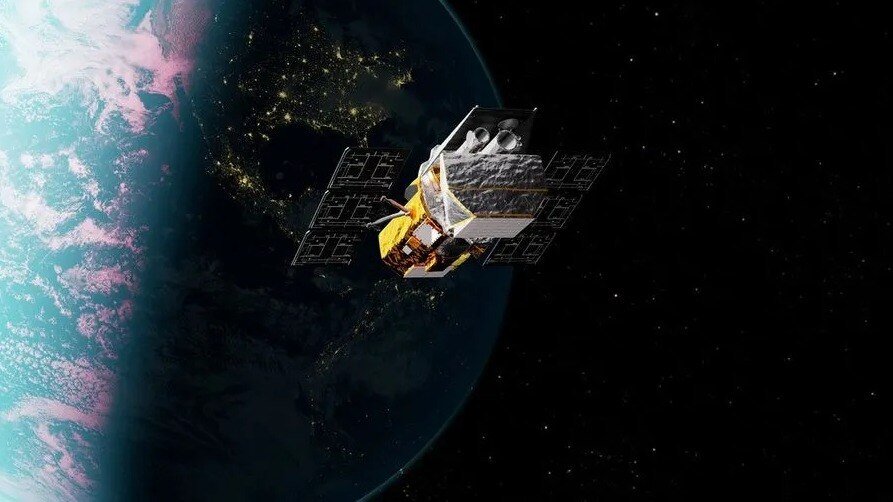
Nasa’s Neil Gehrels Swift Observatory has ended its science operations after nearly two decades of studying some of the universe’s most energetic phenomena, with the spacecraft expected to re-enter Earth’s atmosphere in the coming weeks.



The observatory, which revolutionised the study of gamma-ray bursts and other high-energy cosmic events, was forced to shut down after increasing atmospheric drag caused it to lose altitude rapidly.
The spacecraft could no longer compensate for the effects of drag and entered safe mode on October 20, when it reached an altitude of just 275 kilometres.
The operations team at Pennsylvania State University in University Park subsequently sent a command that effectively ended Swift’s mission and prepared the spacecraft for its eventual atmospheric re-entry.
SOLAR ACTIVITY HASTENED SWIFT’S DESCENT
Like other satellites in low Earth orbit, Swift experiences atmospheric drag as it moves through the thin outer layers of Earth’s atmosphere. Increased solar activity recently intensified this effect, causing the spacecraft to descend faster than anticipated.
A high-risk, fast-turnaround servicing mission intended to boost the observatory’s orbit ended in August without an attempt to raise its altitude.
Swift had temporarily paused science observations to minimise atmospheric drag and extend its time in orbit while the team pursued the boost mission. Following the mission’s conclusion, the spacecraft resumed observations, gathering data on hundreds of targets.
These included remnants of stellar explosions, active supermassive black holes in distant galaxies and comets within our own solar system.
However, restarting observations increased atmospheric drag on the spacecraft, accelerating its descent once again.
A LASTING LEGACY OF COSMIC DISCOVERIES
Launched in November 2004, Swift was designed to detect gamma-ray bursts, brief but extraordinarily powerful explosions associated with cataclysmic events such as the collapse of massive stars and the mergers of compact stellar objects.
Its ability to rapidly identify these bursts and coordinate observations across multiple wavelengths helped scientists investigate their origins and understand the extreme environments in which they occur.
The observatory also contributed to research on black holes, supernovae, stellar flares and other transient astronomical phenomena.
Swift’s observations have helped astronomers study events unfolding across the universe, from nearby stars to distant galaxies billions of light-years away.
Although its scientific operations have ended, the observatory’s extensive archive will continue to provide valuable data for researchers.
As Swift descends towards Earth, its mission will conclude with atmospheric re-entry. Most spacecraft components are expected to experience intense heating during this process, although the precise fate of individual components will depend on the conditions of re-entry.
Its legacy, however, will endure through the discoveries it enabled and the scientific observations it leaves behind.
– Ends