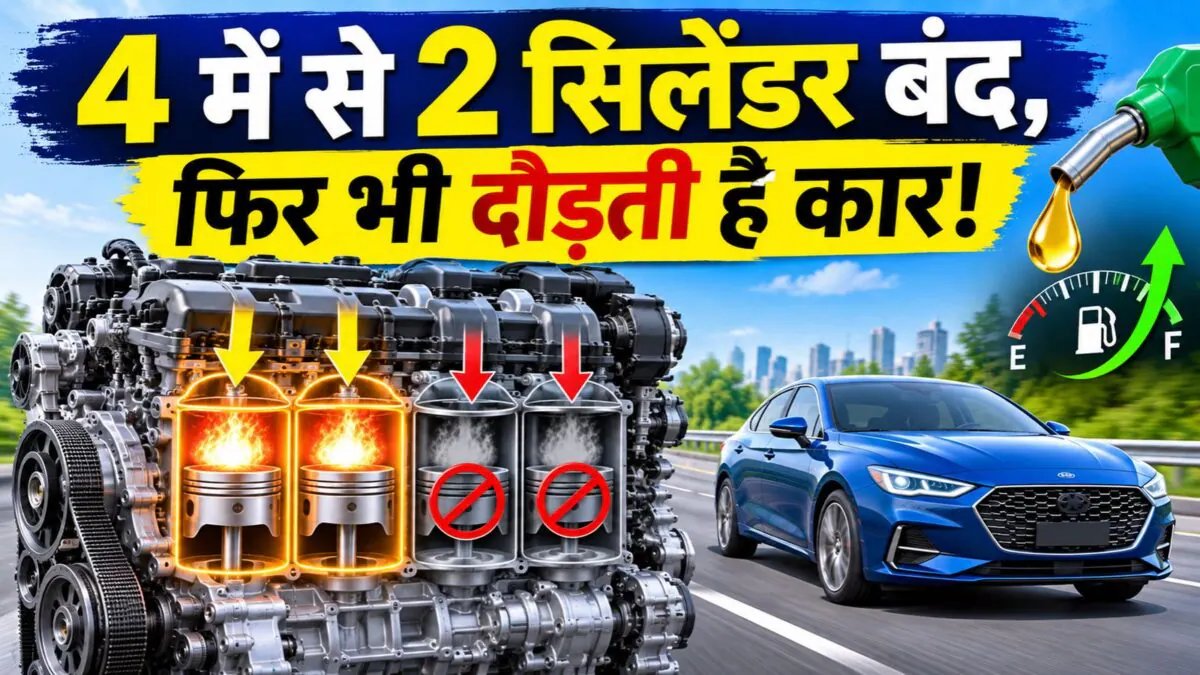
Amidst the rising fuel prices and strict pollution rules in the automobile sector, car companies are continuously working on such technologies which will provide better performance along with better mileage. One of these modern technologies is Active Cylinder Technology (ACT), which is also called cylinder deactivation. Usually when we drive at a steady speed on the highway or at slow speed in city traffic, the engine does not require its full power.



Despite this, all the cylinders of a normal engine continue to work and consume fuel. Active Cylinder Technology is a smart solution to this problem. This technology temporarily switches off some of the engine’s cylinders when not needed, which saves fuel and also reduces carbon emissions. Let’s try to decode this technology.
What is Active Cylinder Technology?
Active Cylinder Technology is an advanced engine management system. Its main objective is to increase fuel efficiency by shutting down half the cylinders of the engine at low load conditions. For example, if a car has a 4-cylinder engine, this technology deactivates two of its cylinders during normal cruising and the car runs on only two cylinders. In India, companies like Volkswagen and Skoda use this technology in their selected cars.
How does it work?
The functionality of this technology completely depends on the engine control unit (ECU) and sensors of the car:
Sensor monitoring: The car’s sensors constantly monitor the engine speed, the condition of the accelerator pedal and the load on the vehicle.
Cylinder closure: When the driver is driving at a stable speed (usually between 1,400 to 4,000 RPM) and does not need much power, the ECU sends a signal. After this, the intake and exhaust valves of selected cylinders are closed and fuel injection in them is stopped.
Instant Refund: As soon as the driver presses the accelerator to overtake or accelerate, the locked cylinders are reactivated within milliseconds. This process is so smooth that the driver does not feel the shock.
What are its benefits?
In cars equipped with this technology, fuel consumption is reduced by 10 to 15 percent. Due to burning of less fuel, emission of harmful gases decreases, which is better for the environment. The most important thing is that the driver gets full engine power and pickup when needed.