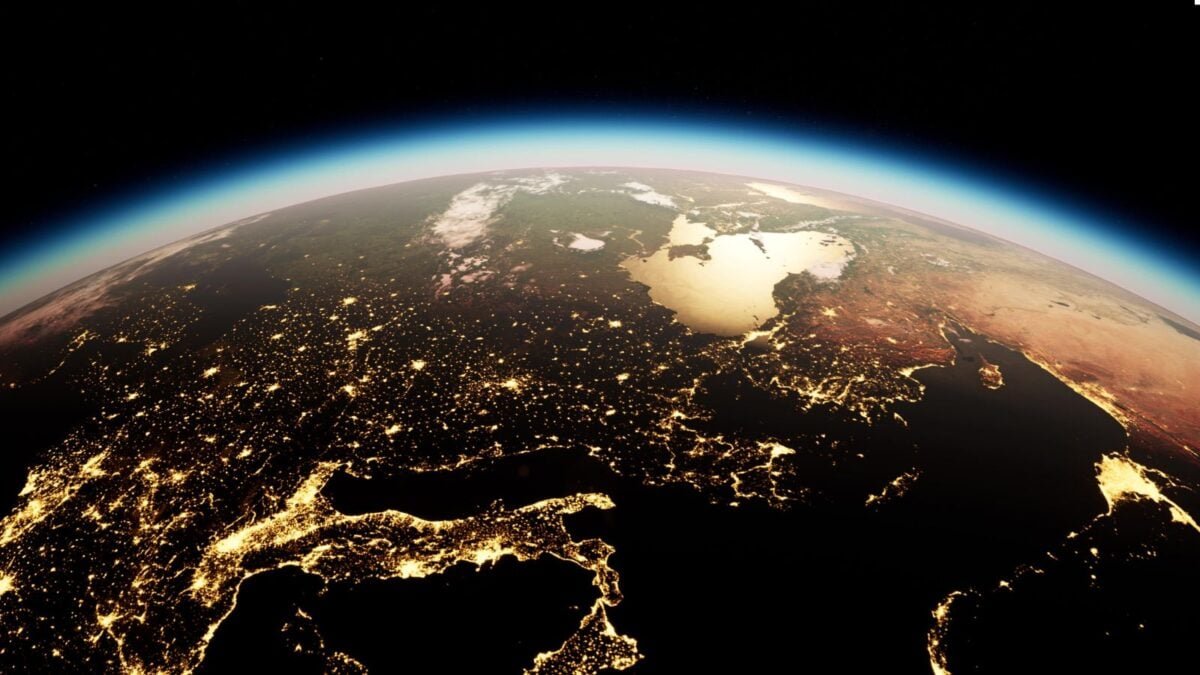
Have you ever wondered what the Earth will be like 1000 years from now? Will humans still continue to live in cities like this, or will apocalypse come? To find the answer to this question, scientists created 10 tech images of the Earth. In this model it is shown where and how the earth will look in a thousand years. At some places you will see progress and at other places you will see a picture of destruction again and again.



This project is part of the research of researchers associated with Janus. In the first research, Jacob Hawke-Misra, George Profitiliotis and Ravi Kopparapu prepared 10 possible scenarios of technological civilization for the next 1,000 years. Its purpose was to find out how human civilization can progress or get trapped in crisis due to changes in technology, resources, society, governance and environment.
How many times can the earth collapse?
After this, in 2026, Celia Blanco, Jacob Hawk-Misra and George Profitiliotis ran a 1,000-year computer simulation on the same 10 scenarios. In this research, it was seen how long a civilization can remain technologically active under different circumstances, how many times it can collapse and how many times it can recover after the collapse.
How were the 10 futuristic models created?
In the first research, scientists used techniques like futures studies, pest analysis i.e. political, economic, social and technological factors and cross-consistency assessment.
This means that scientists did not say that there will be only one way in the future. He looked at different situations by mixing them together. After this, 10 such scenarios were selected, which were interconnected and logical within themselves.
These are the names of these 10 scenarios. Big Brother Is Watching, Wild West, Golden Age, Living with the Land, Transhumanism, Sword of Damocles, Restoration, Ouroboros, Deus Ex Machina and Out of Eden. Somewhere there is lack of resources, somewhere there is excessive technological progress, somewhere there is centralized governance and somewhere there is a model of repeated collapse and recovery of civilization.
Civilization continues to advance in the Golden Age
In the Golden Age model, technology is used to satisfy human needs. The scarcity of resources is greatly reduced and civilization remains stable for a long time.
In this model the earth remains the main center of civilization. Along with this, small settlements may also exist in the Moon, Mars and other parts of the solar system. That is, in this scenario such a balance is created between technology and resources, due to which civilization continues to progress.
Surveillance increases in Big Brother
In contrast, in the Big Brother is Watching model, society takes a very different form due to lack of resources and centralized governance. In this model, technology is used for surveillance on a large scale. Very densely populated urban areas are formed on earth and human activities are monitored through technology. That means technology is far ahead here too, but how it is being used changes the direction of civilization.
Technology itself can become a threat in Sword of Damocles
In the Sword of Damocles scenario, civilization becomes overly dependent on technology. The entire system is extremely complex and in case of any major disruption, it can affect the entire civilization. That means the problem here may not be lack of technology but excessive dependence on it.
Civilization falls and rises again and again in Ouroboros.
The most interesting model is Ouroboros. In this, the development of civilization does not happen in a straight line. Civilization progresses, then collapses due to some major crisis. After this, recovery takes place with the help of the remaining technology and resources and civilization starts developing again. That is, the history of 1,000 years could be the story of falling and then rising several times, rather than of a continuously advancing civilization.
What was done in the research of 2026?
Research published in 2026 put these 10 scenarios into a computer model and simulated them for 1,000 years. Scientists used hybrid deterministic-stochastic model for this. In simple language, some things in the model work according to fixed rules, while probability has been included in some events.
The simulation looked at the civilization’s technological capacity and available resources every year. If resources become too scarce or a major existential threat emerges, the model could lead to civilizational collapse. After this the technological capacity falls and a recovery period begins. After some time, civilization can progress again on the basis of available resources.
Why did scientists run 2,000 simulations?
In the research, the results were not obtained by running the computer model only once. Scientists ran 200 independent simulations of each scenario. A total of 2,000 simulation runs were conducted with 10 scenarios and 200 simulations for each scenario. This helped scientists see how much the outcome could change under different possible circumstances.
Parameters like initial resource stock, resource depletion rate, technology left after the collapse, time taken for recovery and resources recovered after recovery were included in the model.
Some models did not collapse for 1,000 years
In the simulation, the Golden Age and Out of Eden scenarios showed continuous technological activity throughout the 1,000-year model period. Even in the transhumanism model, civilization remained active for a long time in most simulations. In contrast, Big Brother is Watching and Sword of Damocles saw collapse in the initial stages. In these models the first collapse occurred on average 210 years earlier.
What is duty cycle?
An important term in this research is duty cycle. Duty cycle measures how long a civilization remained technologically active over a total period of 1,000 years. If a model has a duty cycle of 1.0, it means that technological activity has continued throughout the model’s entire 1,000-year period. If the duty cycle is 0.38, it means that the civilization remained technologically active for about 38 percent of the total duration of the model.
Repeated collapse and recovery in Ouroboros
On average, about two collapses were seen in the Ouroboros model. Despite this, its duty cycle remained around 0.87. Whereas in the restoration model, the pattern of recovery after collapse was more visible. On an average, there were about 7.5 recovery cycles and the duty cycle was about 0.57.
The Living with the Land model also showed a repeated pattern of collapse and recovery. Its duty cycle was around 0.38. This does not mean that this will actually happen in the future. This is only the result of computer models based on the assumptions that scientists had made for these scenarios.
What is its connection with alien civilizations?
An important part of this research is also related to the discovery of alien civilizations. Scientists want to understand that if a technological civilization exists on another planet, then how can traces of its functioning be identified from space. These are called technosignatures.
The industrial activities of any technological civilization can increase the amount of some gases in the atmosphere. In the research, industrial gases like nitrogen dioxide (NO₂) and some CFCs were seen as examples of possible technosignatures.