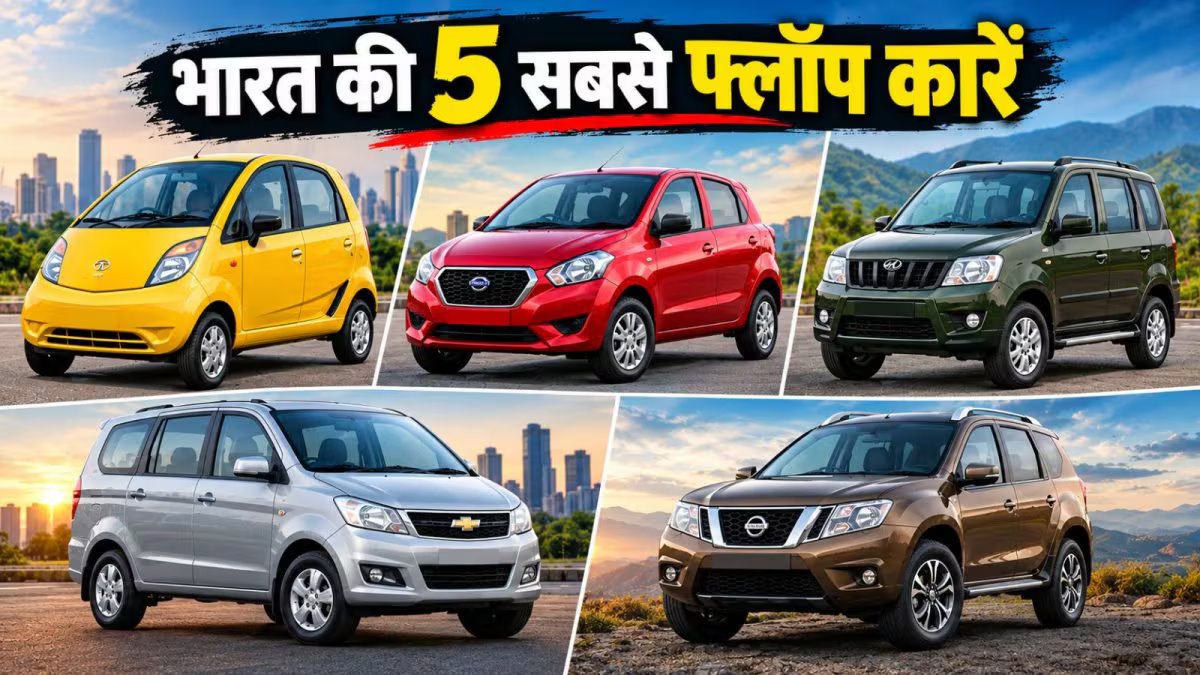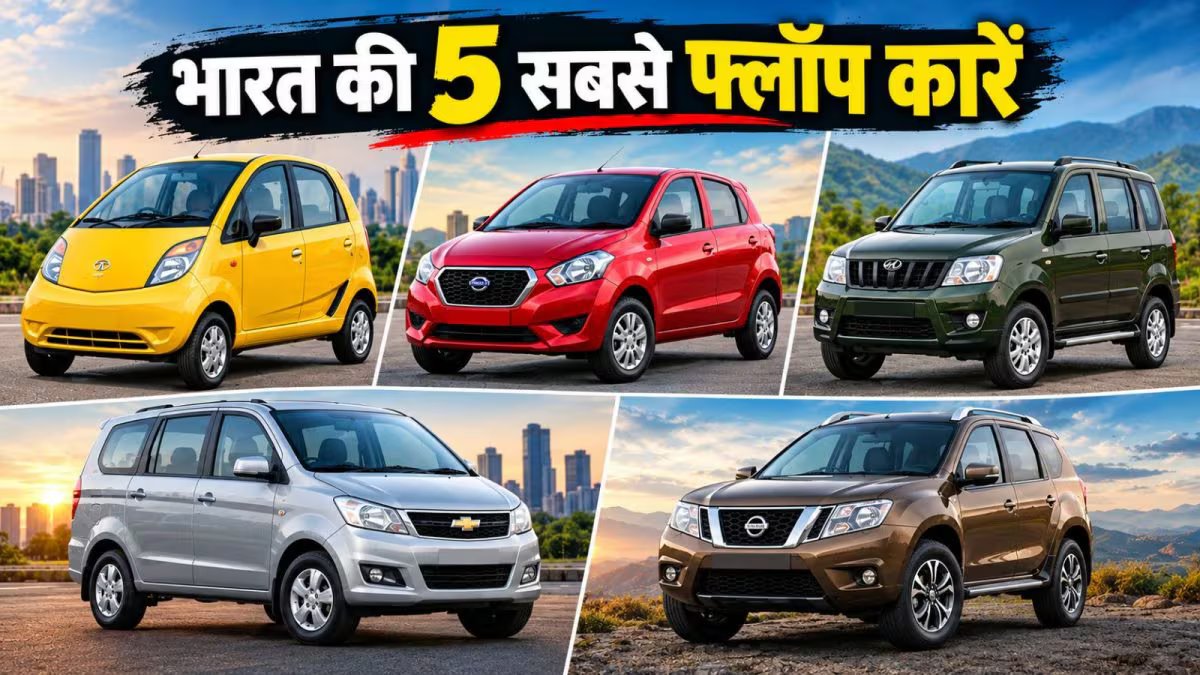
Top 5 Most Flopped Cars in India: The Indian auto market is one of the most competitive and unpredictable markets in the world. Here the success of a vehicle does not depend only on the big brand name or attractive advertisements, but on the social prestige, value-for-money mentality and practical utility of the customers. In India, a car is not only a means of transportation but is also considered a symbol of the family’s prosperity and social status.



Many times, auto companies that were successful at the global level also launched their models with huge investments and big claims, but they completely failed to capture the pulse of Indian customers. Due to wrong positioning, mismatched design, poor build quality and weak strategy, many much talked about vehicles proved to be huge flops in the market. Let us know about those 5 vehicles of India, which were in discussion at the time of launch but later disappeared from the market.
Tata Nano was promoted as an affordable car. (Photo- Overdrive.in)
1. Tata Nano
Tata Nano was launched in the year 2009 as the world’s most affordable car at a starting ex-showroom price of around Rs 1 lakh. Its compact egg-shaped design was designed to meet the city’s tight traffic and to encourage two-wheeler riders to upgrade to cars. Its main identity was the rear-mounted 624cc twin-cylinder petrol engine and excellent cabin space.
However, promoting it as the ‘Cheapest Car’ became its biggest failure. Buying a car in India is associated with social prestige, so people started shying away from the title of ‘cheap car’. In the initial phase, fire incidents and safety concerns also had a deep impact on its sales. At that time Tata Nano was called ‘Lakhtakiya’ car.
Datsun Go was promoted by Aamir Khan.
2. Datsun GO
In 2014, Nissan revived its historical sub-brand Datsun in India and introduced the Datsun Go hatchback at a starting price of around Rs 3.12 lakh. Its design was sporty and sharp, with a hexagonal grille at the front and large cabin space. Its mileage was also better with the 1.2-litre petrol engine. But in order to reduce costs, the company made its cabin very dull.
Even the covered glovebox was missing and the exterior body panels were very light. It received a zero-star safety rating in the Global NCAP crash test, which exposed the weak body structure. This car could not survive the tough competition from Maruti and Hyundai.
Mahindra Quantro was introduced as an affordable SUV. (Photo- Overdrive.in)
3. Mahindra Quanto
Mahindra launched the sub-4-metre Quanto in 2012 to take advantage of tax benefits in the compact SUV segment, with a starting price of around Rs 5.99 lakh. Its front design was similar to Mahindra Xylo, while at the rear it was cut straight. Due to this strange and mismatched box-cut design, this car looked very strange.
It had a 1.5-litre mHawk twin-turbo diesel engine and a 7-seater layout (jump seats at the rear). Due to the heavy ladder-frame chassis and tall body, it suffered from severe body-roll and unstable ride quality. Customers rejected it outright due to poor comfort and strange looks.
The design of Chevrolet Enjoy was like a van. (Photo- Overdrive.in)
4.Chevrolet Enjoy
In 2013, General Motors launched the Chevrolet Enjoy at an aggressive price of around Rs 5.49 lakh to compete with the Maruti Ertiga in the budget MPV segment. Its design was based on the platform of Chinese partner SAIC, which looked very simple, flat and like a commercial van. Its main features were 7 and 8-seater layout, 1.3-litre diesel engine and large cabin.
But the extremely poor plastic quality, loud noise in the cabin and weak safety structure disappointed the customers. It got zero stars in Global NCAP. Its van-like look and weak resale value became the main reasons for its flop.
Nissan Terrano seemed expensive to the customers at that time.
5. Nissan Terrano
Following the success of the Duster under the Renault-Nissan alliance, Nissan introduced the Terrano in 2013 at a starting price of around Rs 9.59 lakh. In terms of design, it looked more premium than the Duster with an aggressive honeycomb grille, sleek headlamps and a muscular stance. Combined with the 1.5-litre dCi diesel engine, its suspension and ride handling were amazing.
But the company kept it more expensive than the Duster by about Rs 1 lakh without any substantial internal or technical changes. Customers did not find it a profitable deal to buy the same cabin and engine at a higher price. Also, Nissan’s limited service network completely blocked its path.