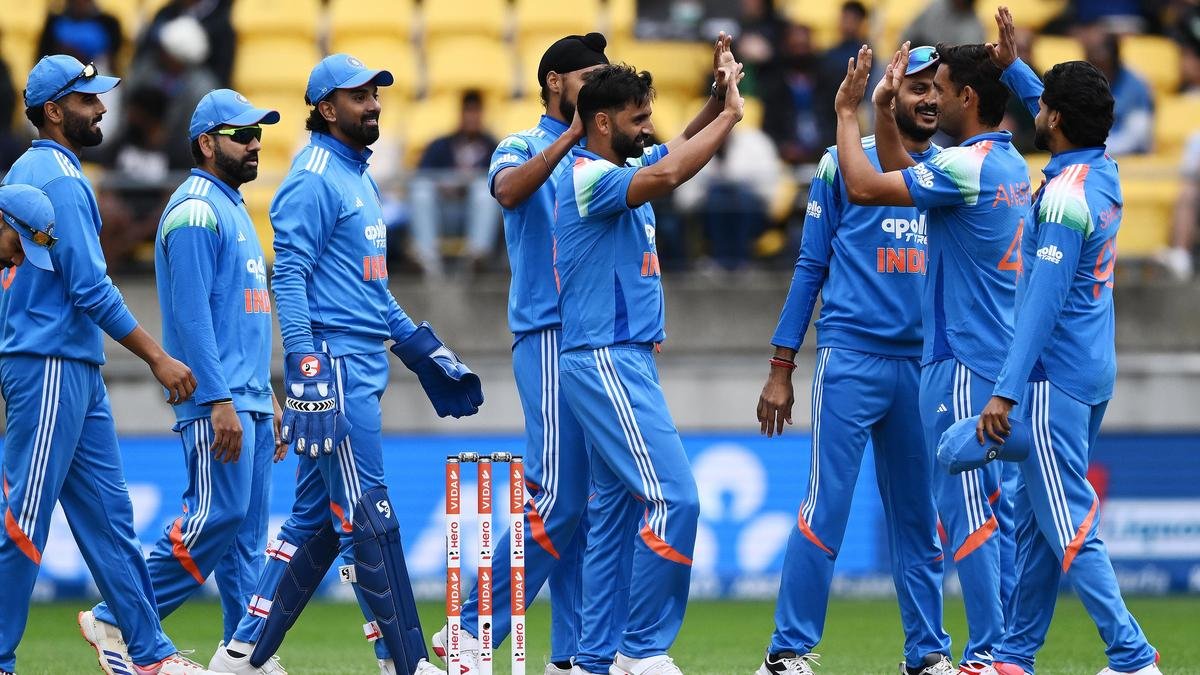
It was a nervy finish, with rain eventually coming to India’s aid, but the four-run win over New Zealand at Wellington’s Hnry Stadium on Saturday was probably a deserved one.



For the second match in a row, the away pace-bowling attack stepped up, skittling the Kiwis for a below-par total. The only difference between the two games was the manner of the chase — a comfortable pursuit in the first and a tense battle in the second.
The Indian bowling attack, with a combined experience of 39 ODIs, has adjusted well to conditions on the Oceanian island; they were a lot more disciplined in their line and lengths in the second encounter.
The pacers bowled 84 per cent of the deliveries in the good and hard lengths, making it difficult for the New Zealand batters to score.
New Zealand missed its lengths more often. Its pacers bowled 18 full deliveries, more than double of that of India (eight).

Wagon wheel comparison showing total runs scored by India and New Zealand in the 2nd ODI in Wellington.
| Photo Credit:
Cricviz

Wagon wheel comparison showing total runs scored by India and New Zealand in the 2nd ODI in Wellington.
| Photo Credit:
Cricviz
Batting second on the track allowed India to pick and choose its area of attack more carefully. The Shubman Gill-led side scored 43 runs through the square leg region, substantially higher than what the host managed.
India also attacked the short deliveries. The batters scored 35 runs through the pull shot in just 14 deliveries, explaining why so many runs were scored through square led and midwicket.
READ: Like fast bowling on vinyl — Thanks for the memories, Mohammed Shami
In contrast, New Zealand managed just 21, with most of the runs coming in front of square on the leg side. The short ball also brought about two dismissals for the Kiwi batters.
Gurnoor Brar was the pick of the bowlers for India, using his tall frame to extract bounce on a two-paced pitch. Among the 60 deliveries he bowled, 31 were directed on the hard length. But two of his four wickets came in the eight balls he bowled short.

Gurnoor Brar pitch map against New Zealand in the second ODI in Wellington.
| Photo Credit:
Cricviz
Gurnoor Brar pitch map against New Zealand in the second ODI in Wellington.
| Photo Credit:
Cricviz
Tom Latham couldn’t control his attempted pull shot and holed out to Naman Dhir at the deep square leg fence. He then scalped Glenn Phillips, arguably New Zealand’s best batter on the tour so far, in the same over with another half-tracker, which resulted in a swirling top-edge that was pouched at fine leg.
The double-wicket maiden forced New Zealand to curb its shot-making and take it deep. He returned to prise out skipper Mitchell Santner for a frustrating 31 with a hard-length ball that took his edge, allowing India to run through the tail after.
“Really enjoyed bowling here in NZ, the bounce and pace. I just try to bowl the hard length that the batters try to pull. Like shoulder level,” Gurnoor told the broadcaster after the game.
The second-string ODI pace attack has done exactly what has been required of them so far and will add to the issue of plenty faced by the selectors and team management.
Published on Nov 07, 2026