Patti Zirhut, a lifelong Republican, has been studying her ballot for weeks. Zirhut eagerly voted for President Donald Trump in 2016, 2020, and 2024, but she isn’t toeing the party line this year. “My ballot is all mixed up,” she says. She’s voting for some Republicans, some independents, and even a few Democrats. Zirhut remains undecided on a few races, but of one thing she is absolutely certain: “I will not vote for Byron Donalds,” she tells me. “No way will I ever vote for him.”



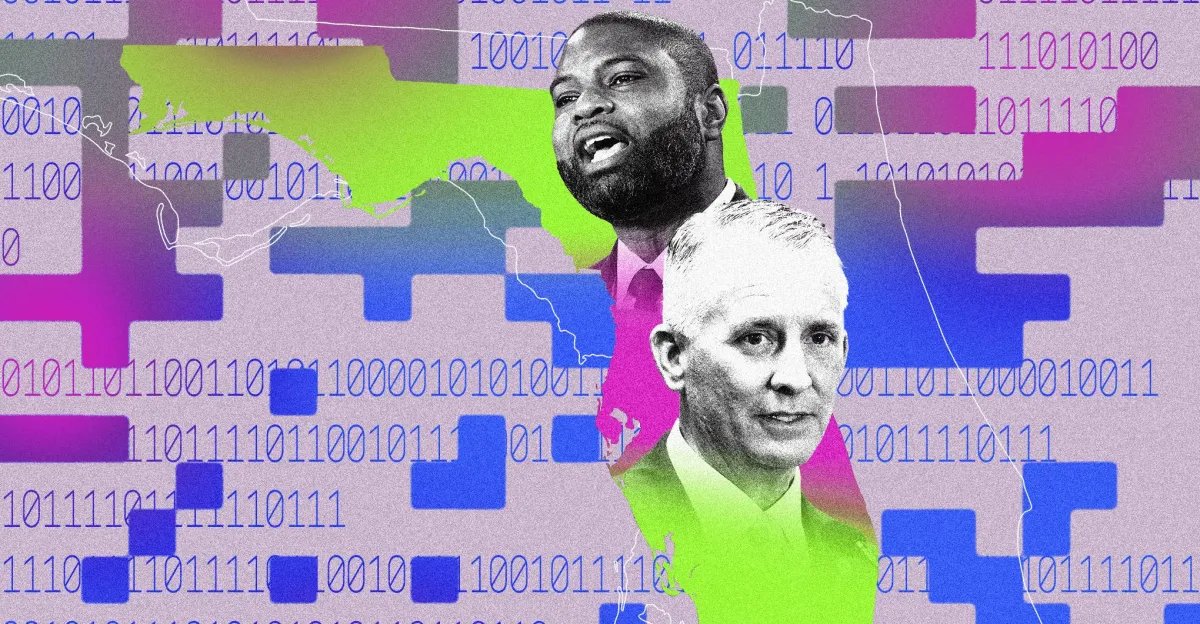
Donalds, the Republican nominee in Florida’s gubernatorial election, has Trump’s endorsement, the party’s backing, and $148 million in campaign funds, much of it from the tech industry. It’s this latest point that particularly rankles Zirhut, an organizer with a group called No Data Center Hernando County, whose purpose is summed up in its name. Donalds has been a vocal supporter of the controversial developments — a fact that may now cost him votes, even among members of his own party.
I first met Zirhut in August at a small protest in the rural community of Spring Hill, Florida. Back then, Donalds was the front-runner in a crowded Republican primary, and Zirhut told me she wouldn’t vote for him if he won. Now Donalds is the nominee in a race that is much closer than anyone anticipated, and Zirhut is sticking to her word. “I’m disgusted with all these dirty politics,” she tells me. She’s thinking about voting for Donald’s Democratic opponent, former Rep. David Jolly.
Jolly, a former Republican who left the party in 2018, is now hoping to win over newly disgruntled conservatives like Zirhut — and his stance on data centers may help him do it. In Florida, the opposition to data centers “is more intense among Republicans than it is among Democrats,” Jolly tells. The Verge“because it is a reflection of the outsized influence and control of Big Tech and Big Data in a world where people are worried about surveillance, whether it’s AI or development encroaching on their land and their freedom.”
When it comes to data centers, the differences between Donalds and Jolly couldn’t be more stark. Jolly has traveled to Virginia’s Loudoun Countyalso known as Data Center Alleyto “see what massive hyperscale data centers really do to a community.” donalds has said he wants to “make Florida the financial capital of the world.” Jolly has promised to implement a one-year moratorium on data center developments. Donalds has said he wants to welcome the tech industry — including data center developers — to the Sunshine State. “There ain’t no bans coming,” Donalds said in August. “But it sounds good on TV, or it sounds good on social media.” Donalds has since moderated his stance on data centers, trying to appeal to the 68 percent of Floridians who say they oppose the developments in their communities.
“This is an opportunity you rarely see in politics for candidates to both lead and follow,” Jolly says. “If 70 percent of the state is saying ‘Don’t do it,’ the job is to listen to voters, not to tell voters they’re wrong. But there are policy reasons, as well, to lead in this moment.”
Jolly rattled off a litany of reasons to slow down, if not altogether halt, data center development in Florida: air and noise pollution; the public health effects on people who live near data centers’ on-site power plants; and environmental concerns including water use, an issue he acknowledged is partially mitigated by the move to closed-loop air cooling. He also pointed to the rapid development of AI technology, which is advancing so quickly that facilities built today “may well be functionally obsolete in the next 10 years.”
When it comes to data centers, the differences between Donalds and Jolly couldn’t be more stark.
Donalds is quick to point out that his running mate, state Sen. Bryan Avila, sponsored a bill regulating new data center projects that requires them to pay their fair share for water and electricity. And he’s emphasized that these developments ultimately aren’t the governor’s purview. “When it comes to data centers and local control, local governments are going to have the final say,” Donalds recently. told cbs news. “Governors don’t issue building permits; local governments do. So if a local community does not want a data center, then no data centers.” But Jolly has saddled his opponent with a nickname that sums up their differences on the issue: “Data Center Donalds.” Donald’s campaign did not respond to a request for comment.
Raul Alfonso, the chair of Watchdogs of Fort Meade, a community group fighting a $2.6 billion hyperscale data center development in deep-red Polk County, said his group has reached out to candidates in the lead-up to the election. Earlier this year, Watchdogs of Fort Meade received what Alfonso describes as a “form letter” from both Donalds and from Ron DeSantis, Florida’s current Republican governor. “It was basically, ‘We have to trust that your local city commissioners and your local city representatives will do the right thing,’” he says. The group hasn’t heard back from Jolly — which doesn’t bother Alfonso much, given Jolly’s promised moratorium. James Fishback, the controversial Republican contender who ended up with 10 percent of the primary vote, was the first to respond. Bobby Williams, a Republican candidate who garnered just 4.1 percent of the vote, has attended several events. Angie Nixon, the Democrat running to unseat Sen. Ashley Moody, hosted a town hall in Fort Meade to discuss residents’ opposition to the data centers. For Alfonso, the difference comes down to a willingness to hear locals’ concerns. Nixon, a Democratic Socialist, has little in common with the far-right Fishback, but both have engaged with the locals fighting the Fort Meade data center in a way Donalds hasn’t.
“There are a lot of people that were deep-red individuals who voted party line all the way, who are looking at flopping over to somebody who will actually take the concerns of the citizens more seriously,” Alfonso says. Alfonso’s voting history skews conservative — he voted for Trump in 2016, 2020, and 2024 — but he was a registered independent until this year, when he switched his affiliation to Republican to vote for Williams in the primary.
Williams, a pastor who had not previously run for office, has since endorsed Jolly. “The Republican Party, they kind of selected their nominee. They had their guy from the get-go: Donalds,” Williams tells me. “Big corporations are obviously buying a lot of these seats. They’re buying the governor’s role.” For Williams, data center developers are the latest in a long list of outsiders that want to have their way with Florida.
If he wins, Jolly will be the first Democratic governor Florida has elected in 28 years. The polls are close. one recent survey conducted by the University of North Florida put Jolly just two points behind Donalds, within the 2.8 percent margin of error. Donalds has several advantages over Jolly, not least of which is money. Jolly has raised $22 million to Donalds’ $148 million. There’s also the fact that Florida, once a swing state, now has nearly 2 million more registered Republicans than Democrats, in part because of DeSantis’ response to the covid-19 pandemic. The fact that Republicans currently lead Democrats in early voting may suggest that the state is unlikely to flip. But some of those Republicans, including Zirhut, are wary of Donald’s support for — and from — the tech industry, and are voting accordingly. Donalds has received $5 million from Leading the Futurea pro-AI super PAC whose funders include executives of OpenAI, Palantir, and Andreessen Horowitz.
As vocal as data center opponents may be, these developments aren’t Florida voters’ main issue. Poll after poll has shown that in Florida and elsewherethe cost of living is top of mind for voters of all political orientations. But Jolly says the mass opposition to data centers is a manifestation of voters’ broader concerns.
“It’s almost a physical metaphor for anxieties around, ‘What is the future of work? What’s the future of wages? What does this mean for security and privacy for myself and for my kids?’” Jolly says. The huge sums of money spent on the governor’s race, he adds, are a testament to economic inequality in a state with an ever-rising cost of living. “In a state like Florida with unlimited money, where people feel like they’ve lost their political and economic power and voice, the deepest-pocketed special interests — be it tech, data, utilities — are able to capture our politicians and decision-making.”