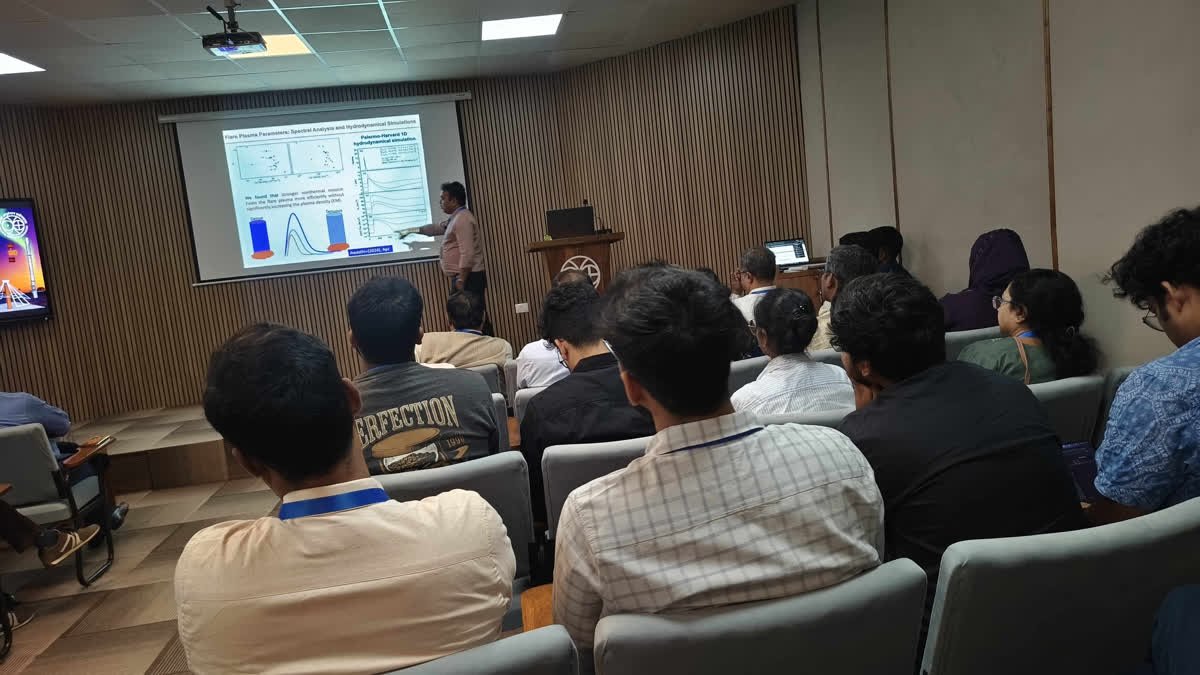



Presentation At National Solar Physics Conference (ETV Bharat)
Udaipur: India will soon be in a position to protect its satellites from adverse solar activity, highlighted Professor D. Pallam Raju, Dean of the Physical Research Laboratory (PRL) at Ahmedabad. Speaking in an ongoing three-day (from October 28 to October 30) National Solar Physics Conference, he said the objective will be achieved by the Disturbed and quiet time Ionosphere-thermosphere System at High Altitudes (DISHA) Mission. It will be executed by the Indian Space Research Organisation (ISRO).
The DISHA Mission aims to study the upper layers of the Earth’s atmosphere (the Ionosphere-Thermosphere system) to understand how solar activity and space weather affect low-Earth orbit satellites, communication links, and navigation systems.
The National Solar Physics Conference is held at Udaipur Solar Observatory, where 75 scientists and researchers from prestigious laboratories, ISRO centres, Indian Institutes of Technology (IITs) and various universities are participating.
Explaining Developments At The Conference (ETV Bharat)
“The DISHA Mission is a twin-satellite mission being developed to study the Earth’s upper atmosphere. Its objective is to understand changes in the ionosphere and thermosphere. Three scientific instruments are being developed as part of the Mission. During solar storms, large quantities of charged particles are directed toward Earth. This creates disturbances in the ionosphere, which can impact satellites orbiting Earth. By getting timely information about solar activity from the DISHA Mission, necessary steps can be taken to protect the satellites from potential damage,” said Professor Raju.
He underlined that India is making rapid progress in the study of space weather. It has continuously strengthened its capabilities in space research, and ISRO now plans to establish an Indian Space Station by 2035. Furthermore, the upcoming Chandrayaan Mission will be crucial for India’s space program.
PRL Director Professor Anil Bhardwaj disclosed that leading physicists and researchers from across the country are participating in the conference that prioritises interaction and discussions rather than traditional lengthy lectures, providing the scientists with an opportunity to share their research and experiences. “It is hoped that this brainstorming session will further accelerate solar research activities in the country,” he said.
Professor Bhardwaj said that the 51st anniversary of the establishment of the Udaipur Solar Observatory is a major milestone for Indian solar research. It marks the entry into a new era. He noted that the state-of-the-art Multi-Application Solar Telescope installed at the institution has completed 10 years. He emphasised the need to provide young scientists with specialised training in modern techniques and solar data analysis.
Former scientist with the facility, Ashok Ambastha, explained that the Solar Observatory was established in Udaipur in 1975, thanks to the efforts of prominent physicist Professor Arvind Bhatnagar. “Clear year-round weather and the presence of lakes were key factors in its selection. Its location amidst lakes helps minimise the impact of atmospheric disturbances on solar observations. A state-of-the-art telescope was installed at the facility about ten years ago. Now 51 years old, this observatory remains one of the country’s most important centres for solar research,” he said.