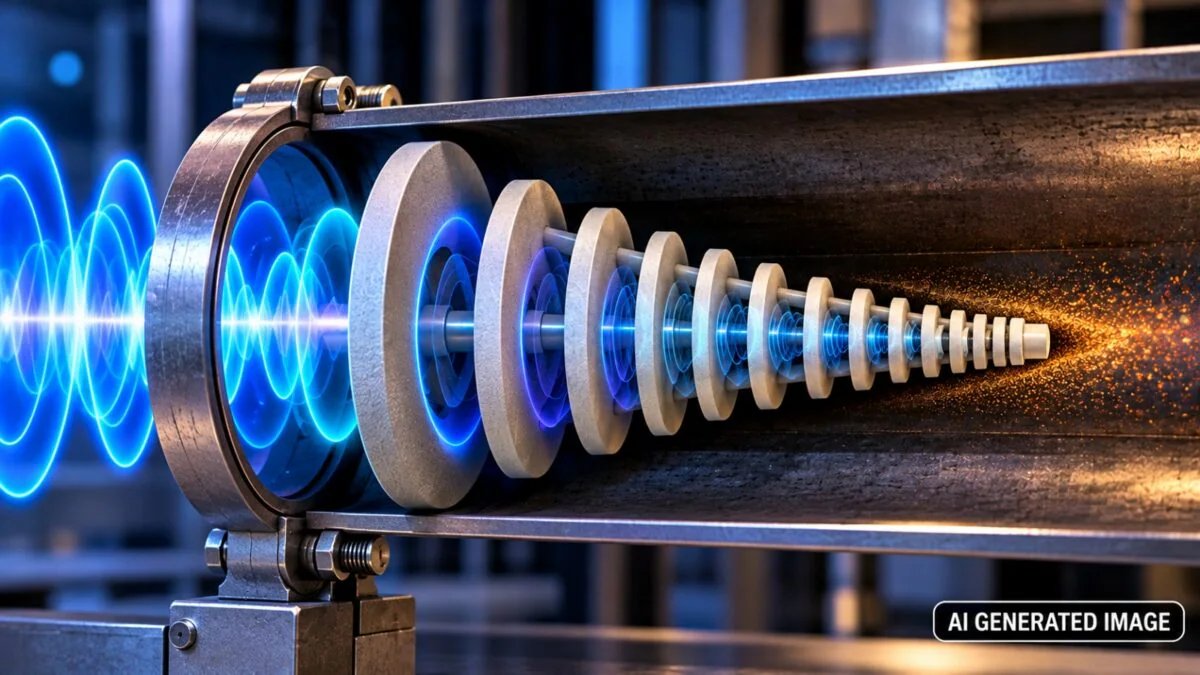
Sonic Black Hole: Sound collides with every surface around us and resonates. This echo proves to be very useful on many occasions, but sometimes it becomes a headache. Especially in closed pipes and ventilation systems, this sound turns into a terrible noise. Scientists from Spain’s University Ramon Llull have found a surprising solution to this problem. He has created such a sonic black hole in the lab, which swallows sound completely. This device is 3D printed and can be directly installed in any running pipe.



How does the sound that echoes in pipes become a problem?
Whenever sound travels in an empty and closed space, its behavior changes. Foam walls are installed in recording studios to prevent echo. It is not at all possible to do this in the pipes of homes and factories.
Air conditioning ducts, ventilation pipes and drainage systems are spread everywhere. When air or liquid passes through these closed pipes, a loud sound is produced. This sound repeatedly hits the mouth or closed edges of the pipe.
After hitting the edges, the sound starts rotating inside. This creates a vibration that shakes the entire structure. This vibration damages machines and causes irritation to humans.
Sound engineer Oriol Guash said, ‘If you stand in front of a closed pipe and shout loudly, after a few moments you will hear a loud echo of your own voice back.’
Traditionally, heavy silencers were installed to stop this noise. Those silencers were very expensive and took up a lot of space inside the pipe. For this reason, scientists were searching for a mild and effective solution.
How do sound waves start behaving like black holes of space?
Scientists have not created a black hole with gravity in the lab. He has created a similar atmosphere by using the special nature of sound waves. When the right structure is obtained, the sound waves become continuously slower.
This situation resembles the famous paradox of the ancient philosopher Zeno. In that principle, the passenger has to cover half the remaining distance every time to reach the destination. That halfway distance never ends completely.
In this sonic black hole the sound wave is actually slow. As the sound wave moves towards the narrower part of the device, its speed continuously decreases. To an outside observer it seems that the wave will never reach its end.
Oriol Guasch said, ‘When a sound wave enters an ideal sonic black hole, it never comes back out.’
The sound wave gets trapped in this maze and loses its entire strength. No person standing outside hears any echo from the end of the pipe. It feels as if the pipe is never ending.
Even if you shout into a closed pipe, the sound will not return, Spanish scientists have prepared a sonic black hole model. (Video: AI Generated)
How is the design of the new Sonic Black Hole different from the older models?
- Scientists have clarified that this is not a magical hole. This is a very precise and measured structure of engineering. This completely changes the path that sound travels within the pipe.
- In older designs, several rings and grooves were made on the inner walls of the pipe. The sound gradually slowed down while passing through those grooves. Its wavelength became shorter and the entire energy was concentrated in one place.
- The biggest drawback of the old model was that it was impossible to install it separately. For this, the entire pipe had to be prepared afresh in the factory. It was almost impossible to fit it into the old system.
- Older systems worked only at a limited number of sound frequencies. Engineer Ji Deng and his team overturned this entire structure. Instead of working on the wall of the pipe, he thought of a system to be installed in the middle.
- The team designed it from the inside out. Looking at it, it looks like a sonic Christmas tree. It can be easily inserted inside the pipe like a plug.
- Oriol Guasch said, ‘The concept is very simple and works very well. It can be made separate from the duct and fitted directly inside.
How did scientists test this device in the lab’s impedance tube?
Researchers took the help of 3D printer to test their new idea. He prepared a prototype 15 centimeters long. A strong rod was given in the center of this entire structure.
A total of 29 round rings were set on this central rod. The diameter of these rings was gradually decreasing from one end to the other. The empty space between the two rings had taken the form of small cavities.
Scientists fitted this prepared model in an impedance tube. This is a special instrument in the lab, which measures the behavior of sound waves. Through this it is known how much a thing is able to stop sound.
Scientists installed a powerful speaker at one end of the tube. With the help of this speaker, sounds of different frequencies were sent inside the tube. Sensitive microphones were installed on the other side, so that the returning echo could be recorded.
The experiment’s setup (left) and the 3D-printed sonic black hole (right), showing rings mounted on a central support rod. This device was inserted into an impedance tube to find out how much sound it reflected. (Deng et al., Applied Acoustics, 2026)
The test results were exactly as seen in the computer simulation. After colliding with the sonic black hole, almost no return of sound was recorded. The device had blocked a large part of the sound within itself.
How does this sonic Christmas tree convert sound into friction and heat?
- Sound is actually a vibration of air molecules. When this vibration enters the tip of the sonic black hole, the structure of the rings reduces its speed. Its wavelength keeps getting shorter.
- As the sound wave moves towards the narrow part, its energy becomes very dense. In a common pipe this energy hits the wall and runs outside. This is why we hear the echo of a loud sound.
- In this new device the sound rubs against the inner surfaces instead of escaping outside. Tremendous friction is created between air and plastic rings. Due to this friction the sound energy starts disintegrating completely.
- This friction converts sound into a little thermal energy i.e. heat. This heat is so slight that it cannot be felt by touch. Due to this change the power of the voice is lost forever.
- It was also found in computer simulation that this design works at a much higher frequency than the old models. The spaces between the rings resonate at high frequency. Because of this, this device easily absorbs many types of loud and heavy noises.
What changes will be seen from this new technology from factories to homes?
The first and direct benefit of this discovery is going to be to the noise control industry. In today’s era, exhausts and blowers of big factories make very loud noise. The hearing ability of the workers working there is adversely affected.
This 3D printed device can be inserted into old pipes without any vandalism. This will save huge expenses of the companies and make the work place quieter. Its use in the ventilation system of hospitals will also provide great relief.
This technology can also be used in airplane engines and car exhausts. If the weight of the silencer is reduced, vehicles will consume less fuel. This will also prove to be a big step from the environmental point of view.
Scientists no longer want to limit this technology to pipes only. They are planning to mold it into 2D and 3D structures. If this happens, then it can be used on the walls and ceilings of the rooms.
This can bring a big change in the field of architecture. A large auditorium can be made completely soundproof without using thick and heavy foam. Traffic noise coming from outside inside the houses will also be stopped.
What are the challenges in deploying this device in the real world?
The calm and controlled environment of the lab is quite different from the real world. The research team is well aware that many hurdles will have to be overcome before launching it in the market. The biggest problem is dust and garbage.
A huge amount of smoke and dust rises in factories and exhaust pipes. If dust particles accumulate between these 29 rings, the cavities will close. As soon as the cavities are closed, the acoustic effect of this device will end.
The second big challenge is temperature and high wind pressure. Hot gases move with very fast flow in industrial pipes. The device will have to be made of such material that can withstand the pressure of high wind without melting.
Scientists will now have to find such strong materials that can last for a long time. Besides, such technology will also have to be thought of by which this device can keep itself clean. To solve these problems, further trials are going on at a rapid pace.
Oriol Guasch said, ‘The most exciting thing for me is the physics and mathematics behind it. Till a few years ago, controlling waves in this way seemed like science fiction.